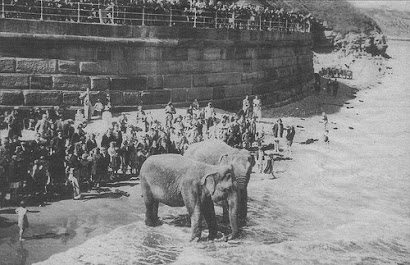
ELEPHANTS ON WHITBY BEACH

ELEPHANTS ON WHITBY BEACH

Wednesday, 21 March 2012

THE DANZIG

The cruisers of the Bremen class consisted of seven ships in all. Apart from one (The Lübeck, which had a turbine engine) they all relied on triple expansion engines. They were manouverable vessels, but notorious for rolling badly when the seas became stormy. All were named after German towns.

Even at the start of World War I they were not modern ships and several were lost. Nevertheless some survived throughout World War II, although not as combat vessels.

Prior to World War I the small cruiser Danzig was utilised in fleet operations and in artillery training. In 1914 she was once again used in fleet operations. She took part in the battle of Helgoland and was involved in operations at the Baltic Islands.

In 1919 the Danzig was delivered to England to be scrapped. This photograph shows her in Whitby harbour at the end of her final voyage. She was dismantled between 1922-1923.

Tuesday, 20 March 2012

THE PLAGUE BIBLE


 During the 18th century the Quarantine or Plague Bible was commonly used in England as the first measure of defence against the deadly and highly contagious disease The Plague.

 The first Act of Quarantine was not officially established in England until 1710, some forty years after the country had last suffered at the hands of the Plague. The act itself would undergo several further amendments throughout the 1700’s, each one becoming progressively more stringent. Until eventually in 1824 the laws were finally relaxed, making the act of quarantine only at the discretion of the privy council. 

Up to this point a ship suspected of carrying the plague was placed in isolation for forty days at a distance of up to three miles off shore. The problem with this was that the Master of the quarantined vessel had to then present a report to the local port authority within the first 24 hours, which meant that at some point the Customs Official dealing with the case would have to come into physical contact with the ship’s crew, leading to the possibility that he could catch the disease himself.

So to resolve this problem the Plague Bible was introduced and Whitby, like all major sea ports that dealt with imported goods, immediately began using this rather simplistic and very honest method as a means of verifying whether it was necessary to quarantine a ship or not.

A Boarding Officer (tide surveyor) and a tide-waiter plus a crew of six would use a purpose built coble - a small locally built fishing boat - to a approach the quarantined vessel. Making sure that they were to the windward side of the ship, the Boarding Officer would then hail the ship’s Master.

Then, using a boat hook to hold up a metal encased copy of the New Testament, the Customs Official would make the Master swear an oath upon the Bible that neither he nor any member of the crew needed quarantine. On assuming that the ship’s Master was a Christian, and also that he was actually telling the truth, the vessel was then deemed safe enough to board.

It is also worth noting that in some sea ports across England a copper encased Bible would be fixed to a line and passed over to the quarantined vessel. Once the ship’s Master had sworn his oath, the Bible was cast overboard and dragged back through the sea to the official’s boat, a process which was believed to cleanse the book of  any disease and impurities it might be carrying.   

Sunday, 27 November 2011

LIONEL CHARLTON AND HIS HISTORY OF WHITBY 1779

After a classical education at the University of Edinburgh, Lionel Charlton settled in Whitby around the year 1748. He was a lame man with a withered hand, yet these obstacles did not prevent him from setting up a school which was for many years the principal one in Whitby.

Considered by many a strict schoolmaster, he was nevertheless a man of great integrity and would not accept anything other than his agreed salary from his employers. He was stubborn in attitude and never surrendered his point of view in an argument.

Around 1762 Charlton published a paper claiming that extracting money from the local fishermen in taxes known as tithes was unjust. Dr. Hayter, Bishop of Norwich, was in charge of this process, and he felt this paper reflected badly on his character, especially as Charlton seemingly pulled no punches whilst voicing his opinion of the Bishop.

The South East Prospect of Whitby Abbey 1773
Dr. Hayter threatened to prosecute Charlton unless he retracted his 'obnoxious expressions'. True to his character Charlton refused point blank, immediately putting his career, the safety of his family and his financial security in peril. This incident may well have ruined the dogmatic schoolmaster had the Bishop not died , putting a stop to the prosecution.
 
Toward the end of his life, after a long acquaintance with the town, Lionel Charlton undertook the writing of his History of Whitby. Having his employer Mr Cholmley's library at his disposal and access to the records of the Abbey, several years were spent in research.

The title page and the canvas map
Before September 1776 about a hundred subscribers were obtained. In 1777 the book was advertised as 'speedily to be published'. Even so the subscribers had to wait unti 1779 before holding the long anticipated volume in their hands.

This First Edition contained a canvas fold out map of Whitby which was reprinted by Young in his history of the town in 1817. Charlton's book is not an easy read. It is arranged chronologically, therefore subjects are not gathered together, but occur piecemeal throughout the work. It contains a huge amount of charters and exhibits 'a greater display of laborious research than of solid judgement'.

Many thanks to Mr Stephen Boddy for lending me his precious first edition of this book

Thursday, 10 November 2011

ABSOLUTE ZERO

This is a slightly unusual post from OUT ON YE! as it is music related, but it is also kind of literature related (in the widest sense) so I thought this might be the place to publish it.

Long thought lost to the world (and some would say for the better) I came across this fanzine dedicated to the Whitby music scene. It came out in 1987, and I clearly remember pounding away on an old typewriter deep into the early hours of the morning producing it.

It ran for two issues, and this premiere publication includes interviews with M.O.D., Sons of Gods Mate, live reviews of the likes of Indian Dream and Chumbawamba, a cartoon or two and a Wilfred Owen poem to round things off.

Click on the images for a readable version.


Sunday, 6 November 2011

LEECH ON THE BEACH

On the 24th of September this year we were down by the beach when my five year old daughter Iris came up from the sand clutching something in her hand. It looked like a curled up worm with a flattened body, and I couldn't recognise it as one of the creatures normally found on the shore.

Placing it in a paper cup of sea water, it stretched out and fixed one end of its body to the side of the cup with a sucker. It was clearly a leech. After taking a few photographs for identification purposes, the leech was placed in a pool under some rocks so it could crawl away from predatory seagulls until the tide came in.


At home, despite consulting numerous identification guides I couldn't find a match. Marine leeches prey on fish and are usually found attached to them when they are caught. It didn't look like a marine leech.

The photos were posted on the Wild About Britain water life forum and It's fair to say they caused much consternation. Someone even suggested that it might be a juvenile hagfish (a jawless fish similar to a lamprey). Of course the sucker and highly extendable body precluded this. It was certainly a member of the Hirudinea, the leech family.


There are lots of pipes that drain water from the cliffs onto the beach just below where our beach hut is situated, and it struck me that this might not be a marine species at all, but a fresh water or terrestrial creature that had been washed out of one of these ducts. Indeed the most likely ID turned out to be the rare terrestrial leech Trocheta subviridis.

Quite capable of living in water with a high level of pollution from sewerage, the leech was undoubtedly living in one of the drainage pipes and was flushed out onto the sand. Trocheta subviridis is a predator of earthworms and leaves the water to hunt. There are reports of it crawling up plugholes into people's sinks and it is sometimes dug up in gardens. Because of its lifestyle it is sometimes called the Amphibious Leech.

In the journal Parasitology, vol. III, p. 182 ther is an account of one being found on an allotment in 1922.
In April of this year a specimen was sent to the Agricultural Department, Armstrong College, by Mr S. Giles of South Shields, along with a note explaining that it had been found “down in the first spit of the soil” in one of a group of allotments there. It was obviously a specimen of a leech, but the specimen was submitted later, to Mr John Ritchie, the Museum, Perth, who kindly identified the species as Trocheta subviridis, and who mentioned that "this gives so far as I am aware, a more northern habitat than hitherto recorded".
 
 
Definitive identification of leeches needs to be carried out when the creature is still alive and its body relatively transparent. Also a handlens is essential to count eye spots. This has been a lesson to me. Now whenever I go to the beach, I always take a magnifying glass of some sort. You never know what you might find.

Sunday, 16 October 2011

A TALE OF TWO WRECKS

By Richard Locker

I dared not go below, I dared not leave the helm so here all night I stayed, and in the dimness of the night I saw it - Him! God forgive me, but the mate was right to jump overboard. It is better to die like a man; to die like a sailor in the blue water no man can object. But I am captain, and I must not leave my ship. But I shall baffle this fiend or monster, for I shall tie my hands to the wheel when my strength begins to fail, and along with them I shall tie that which He - it! - dare not touch; and then, come good wind or foul, I shall save my soul, and my honour as a captain.

Taken from the log of the ‘Demeter’ (Varna to Whitby)


 On the 24th October 1885 the town of Whitby bore witness to an incident that would later become the basis for one of the most famous shipwrecks in the history of literature.

The following extract is taken from an article that appeared in the Whitby Gazette on the 31st October 1885.

A little later in the afternoon a schooner was descried to the south of the harbour, outside the rocks. Her position was one of great danger; for being evidently unable to beat off, there seemed nothing for it but to be driven among the huge breakers on the scar. Her commander was apparently a man well acquainted with his profession, for with consummate skill he steered his trim little craft before the wind, crossing the rocks by what is known as the ’sledway’ and bringing her in a good position for the harbour mouth.

The piers and the cliffs were thronged with expectant people, and the lifeboat ‘Harriot Forteath’ was got ready for use in case the craft should miss the entrance to the harbour and be driven on shore. When a few hundred yards from the piers she was knocked about considerably by the heavy seas, but on crossing the bar the sea calmed a little and she sailed into smooth water. A cheer broke from the spectators on the pier when they saw her in safety.

Two pilots were in waiting, and at once gave instruction to those on board, but meanwhile the captain not realising the necessity of keeping on her steerage, allowed her to fall off and lowered sail, thus causing the vessel to swing towards the sand on the east side of the harbour. On seeing this danger the anchor was dropped, but they found no hold and she drifted into Collier’s Hope and struck the ground. She purported to be the schooner ’Dmitry’ of Narva, Russia, Captain Sikki, with a crew of seven hands, ballasted with silver sand. During the night of Saturday the men worked incessantly upon her that her masts went by the board and on Sunday morning, she lay high and dry a broken and complete wreck, firmly embedded in the sand.
  
The wreck of the Dmitry (Frank meadow Sutcliffe)
The connection between the Irish author Bram Stoker and Whitby are very well documented, it is also well known that the wrecking of the Russian schooner the ‘Dmitry’ inspired Stoker to create one of the most memorable scenes in Dracula - the arrival of the Count in England.
 
…leaping from wave to wave as it rushed as headlong speed, swept the strange schooner before the blast, with all sail set, and gained the safety of the harbour. The search light followed her, and a shudder ran through all who saw her, for lashed to the helm was a corpse, with drooping head, which swung horribly to and fro at each motion of the ship. No other form could be seen on deck at all. A great awe came on all as they realised that the ship, as if by a miracle, had found the harbour, unsteered save by the hand of a dead man! However, all took place more quickly than it takes to write these words. The schooner paused not, but rushed across the harbour, pitched herself on that accumulation of sand and gravel washed by many tides and many storms into the south-east corner of the pier jutting under the East Cliff, known locally as Tate Hill Pier.

The Flag of Distress: The brig Mary and Agnes (Frank Meadow Sutcliffe)
 The Dmitry was not the only vessel to come to grief at Whitby on the 24th October, earlier in the day a Scarborough brig named Mary and Agnes was pounded ashore whilst sailing from Newcastle to London with a cargo of scrap iron. This incident appeared to be even more dramatic than that of the Dmitry as this
passage taken from the same Gazette article dated 31st October 1885 illustrates.

In the mean while the lifesaving brigade by a well directed rocket threw a line over the brigantine which now was seen to be the Mary and Agnes, of Scarborough. It seemed a long time before the crew on board fixed the apparatus, but eventually this was done, and the youngest of them, a lad of about fifteen years, was sent ashore in the breeches. In being dragged towards the shore the poor little fellow was struck by many seas and considerably buffeted about. There were, however, many ready and willing among those on shore to rush into the water and bring him to land.

What makes this day’s events all the more dramatic is that both shipwrecks were captured on camera by the famous Victorian photographer Frank Meadow Sutcliffe.


Friday, 16 September 2011

THE WALKING MEN

The ongoing battle to save Whitby's iconic piers demands that all of us realise what an incredible feat of engineering it took to build them.


Looking at these photographs taken in 1913 you could almost be forgiven for thinking that Whitby had been invaded by Martian machines, reminiscent of those found in H.G. Wells’ War Of The Worlds, whose sole aim would appear to be the destruction of the town.

But these ’Walking Men’ as the machines were colloquially known, were in fact here to build the east and west pier extensions, a necessary improvement which helped vessels trying to negotiate the sometimes treacherous harbour mouth.


Saturday, 10 September 2011

FLINT JACK: PRINCE OF COUNTERFEITERS

By Richard Locker


The Victorian era was an age teeming with heroes and villains, from an abundance of pioneers, inventers and forward thinkers, to the numerous ‘evil’ empires that sought to knock Great Britain from its imperial throne. Even the privileged and academic worlds of geology and archaeology had their share of good and bad from such luminaries as Charles Lyell and Lieutenant - General Augustus Henry Lane Fox Pitt Rivers right through to the villainous, like the infamous anti-hero Flint Jack (aka Jack Flint, Fossil Willy, Bones, Shirtless, Cockney Bill, the Old Antiquarian, Snake Billy, Skin and Grief).

Edward Simpson was born in 1815 in the village of Sleights. The family appeared unexceptional, his father been a sailor, and it was probably assumed that the young Edward would follow in his footstep when he eventually came of age. But his life was destined to take a different path when at the age of fourteen Edward became a servant to the local Geologist and Historian Dr George Young.

It seemed that this is where Edward learnt the rudiments of his trade as he followed Dr Young on his fossil - hunting expedition along the Yorkshire coastline. Some time later he left the services of Dr Young and took up with a Dr Ripley who was also a keen local historian.

After Dr Ripley’s death Edward ostensibly became an itinerant worker and it was on these tramps that he began to acquire his numerous aliases. At first he etched out a meagre living by gathering fossils found along the cliffs of Whitby and selling them to the local dealers. In 1841 he extended his ‘walks’ to include Scarborough, Filey and Bridlington, where he also became quite an expert in cleaning the fossils.

But it was on a return visit to Whitby when Edward met with a dubious character called Mr Dotchon, who showed Edward his first flint arrow head. Mr Dotchon went on to inquire if it was possible for Edward to replicate the arrow heads. Edward, fascinated by this questionable venture, decided to take up the proposition, and so it was that Flint Jack was born.

Replicating the fine workmanship of a genuine flint arrow head was a lot harder than Flint Jack had first imagined. In his despair Jack decided that however the Ancient Britons had crafted such tools had long been lost to antiquity, until one day when, purely be accident, he finally discovered a means of achieving the desired effect.

It was said that one morning whilst Jack puzzled over the intricacies of a flint arrow he became distracted by a damaged gate, he took off the hasp which was hanging loose and absentmindedly struck the ring against a piece of flint. To his astonishment off flew a fine flint flake and upon trying again and again he soon discovered he had found the perfect tool for his needs.

 
This was the defining moment that sent Flint Jack head long on his deceitful enterprise, along with flint tools he also set about reproducing British and Roman urns, which he manufactured first in Bridlington and then in a hut at Stainton Dale in the vicinity of Raven Hall, but possibly the most unscrupulous ‘find’ was ‘discovered’ in 1846 at Pickering, when he used an old tea tray to fashion a piece of armour. The Roman breast plate, he claimed, was unearthed at a site near Cawthorne camp on the outskirts of town. In fact he was so proud of his ‘discovery’ that when he had finished it he put it on and marched into the town of Malton, where he immediately found a buyer for the piece.

Jack eventually branched out and after teaming up with an art dealer named Block in Colchester move onto London, where Block acting as Jack’s agent set about selling the ‘finds’. It is no small credit to Flint Jack’s ingenuity and charisma that he was able to fool the establishment for so long . For not only did he pray upon the amateur Victorian collector he was also able to sell artefacts to museums and other serious collections across the country, including numerous pieces to the British Museum itself.


But in the end it seems that Flint Jack was his own worst enemy, as this passage from the Whitby Gazette at the time proclaims :-

It is to be regretted that a man so capable should be destined to waste his information among the occupants of the common lodging-house or the beer-house kitchen. On being asked recently, in Malton, what he would do if he was put into a hogshead of beer, he replied, “I would drink myself dry!”. Such is Flint Jack.

The following excerpt is a concise account of Flint Jack’s trial published in the Whitby Gazette on 19th March 1867

"Flint Jack" - A notorious Yorkshireman - one of the greatest impostors of our times -was last week sentenced to 12 months imprisonment for felony at Bedford. The prisoner gave the name of Edward Jackson, but his real name is Edward Simpson, of Sleights, Whitby, although he is equally well known as John Wilson, of Burlington, and Jerry Taylor, of Billery-dale, Yorkshire Moors. Probably no man is wider known than Simpson is under his aliases in various districts - viz. "Old Antiquarian", "Fossil Willy", "Bones", "Shirtless","Cockney Bill", and "Flint Jack", the latter name universally.

Under one or other of these designations Edward Simpson is known throughout England, Scotland and Ireland - in fact, wherever geologists or archaeologists resided, or wherever a museum was established, there did Flint Jack assuredly pass off his forged fossils and antiquities. 

He imbibed, however, a liking for drink, and he admits that from that cause his life for 20 years past has been one of great misery. To supply his cravings for liquor he set about the forging of both fossils and antiquities about 23 years ago.

In 1859, during one of his trips to London, Flint Jack was charged by Professor Tennant with the forgery of antiquities. He confessed, and was introduced on the platform of various societies, and exhibited the simple mode of his manufacture of spurious flints. From that time his trade became precarious, and Jack sunk deeper and deeper into habits of dissipation, until at length he became a thief, and was last week convicted on two counts and sent to prison for 12 months.
NORTH YORKSHIRE RAILWAYS: A SENTIMENTAL JOURNEY


This film, made by railway enthusiast Frank Dean in 1966, shows the last journey made along the Whitby to Scarborough railway line prior to it being dismantled in the devastating Beeching cuts. The narration is excellent and the music chosen surprisingly evocative and haunting.


The film largely speaks for itself, beginning with a man reading news of the line closures in a copy of the Whitby Gazette (when it was still a broadsheet) on Whitby Station. Frank and his wife Heather spent every weekend filming the Yorkshire lines scheduled to be axed by Dr Beeching's destructive purge.

Tagged onto the 1966 film is a section shot in 1967 in which contractors travel the length of the line stopping at stations along the way to gauge the value of railway property and see what can be sold for profit.


For people who may know the place well, at around 2.50 minutes is a view of the Whitby Gasworks with the gasometers still in place.

The film ends with the sad sight of workmen lifting the tracks of what must have been one of England's most beautiful stratches of railway.


More information on Frank Dean and his films at the Yorkshire Film Archive

Saturday, 11 June 2011

SUMMER BREAK


Unfortunately OUT ON YE! will be taking a short break until September. I need to do a study course for work which is going to take up quite a bit of time, so rather than publish rushed and poorly designed posts, I'm putting the blog on hold for a bit.

Don't panic though!

Regular contributor Richard Locker has just started his own blog Thoughts in Fits and Starts. Its brand spanking new and well worth a visit.

OUT ON YE! will be back in September. Until then, have a marvellous Summer.