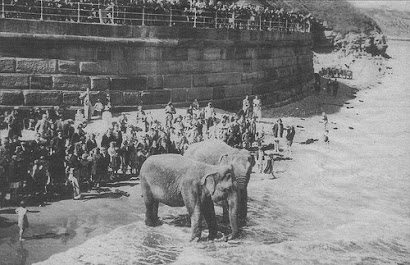
ELEPHANTS ON WHITBY BEACH

ELEPHANTS ON WHITBY BEACH

Thursday, 14 May 2026

THE FIRST AMERICAN MODERN: THOMAS CHAMBERS (1808 - 1869)

Fire at the Theatre, Skate Lane, 1823
by George Chambers Senior

n W

In Whitby museum is a striking painting of a fire that broke out on the night of July 25th, 1823 at Whitby's theatre. The building was at the junction of Newton Street and Skate Lane which is these days called Brunswick Street. Aged only 20, a young local artist named George Chambers (1803 - 1840) captured the scene on canvas. He would later go on to become a renowned and much admired marine painter. The life of his brother Thomas was however far more obscure and unusual.

The brothers were born into poverty in Whitby, their father was a merchant seaman and their mother a laundress. George, being recognized as a talented artist, was released from his maritime apprenticeship to take up painting as full time employment. Thomas undoubtedly learned skills and techniques from his older sibling, although his style was much less conventional.

In 1832, at around the time George gained the patronage of King William IV, Thomas emigrated to New Orleans where he filed his intent to become a naturalized citizen. His employment was listed as a painter and restorer. He frequently moved around the states from New York to Baltimore, Boston and Albany before returning to New York and finally back to England. His paintings were never exhibited during his lifetime. 

They were often of marine subjects, as were his brother George's, no doubt influenced by early experiences working in the port of Whitby. He often drew inspiration from popular engravings of the time of naval battles and suchlike. Thomas also painted numerous landscapes with a particular penchant for the Connecticut and Hudson River Valleys. It's worth noting that there was at the time a movement called the Hudson River School of Painting, but he remained outside the orbit of those artists.

He sometimes signed the work of which he was presumably most proud with 'T. Chambers', although many pieces went unattributed and it seemed his art was destined to be forgotten, languishing in barns and attics across America, unseen and consigned to oblivion.


The Constitution and the Guerriére
Thomas Chambers c.1840-50.

In 1942 collectors discovered a signed painting of a battle at sea, The Constitution and the Guerriére (1840-1850). This allowed other works to be definitely attributed to Chambers and collected together. That same year an exhibition was held at the Macbeth Gallery in New York which in its title heralded the arrival of "T. Chambers, First American Modern." 

Lake George and the village of Caldwell
The Connecticut Valley
Packet Ship passing Castle William, New York harbour
To me the shapes Chambers uses to depict hills, trees, ships and buildings seem solid and bold. His clouds look physically present and not at all ephemeral. It's not dissimilar to a cartoon representation of the world, each object having absolute boundaries. Often described as a naive, primitive style and said to be in the zone between folk art and fine art, his use of rhythm and interacting, simplified forms makes his work seem undeniably modern, especially as these paintings are products of the mid nineteenth century.

In 2008 Kathleen A. Foster, the American art historian, critic, and curator published the book Thomas Chambers: American Marine and Landscape Painter, 1808-1869. It is a painstaking piece of critical research examining Chambers' creative style, the environment in which he produced his art and an outline of his journey through life. It is available in full as a free PDF and includes many vivid images (see links).

Around 1866 Thomas returned to England penniless and in ill health. He died in the poorhouse in Whitby, the official registration of his death on November 24, 1869 was filed in London. The cause of death was given as “softening of the brain” and “paralysis.” Thomas Chambers, son of Whitby, was buried in Larpool Cemetery. So far I have been unable to locate his grave.

LINKS

Friday, 8 May 2026

THE HAND OF GLORY

A RECIPE

The Petit Albert is an 18th century grimoire of natural cabalistic magic. Supposedly authored by Albertus Magnus (Albert the Great), a professor at Sorbonne University born around 1193. It is a collection of works from various sources and a companion volume to another grimoire, The Grand Albert.

The Petit Albert contains instructions for making a Hand of Glory, the only extant example of which resides in Whitby Museum. The grisly charm was used to render the occupants of a house comatose so burglary of the property could take place. As long as the flame burned, the sleepers would not awake. In one version the clenched hand is used as a candleholder for a candle incorporating human fat, but in another the outstretched hand has its own fingers lit. 

Should you choose to make such an object for some nefarious purpose, here are the instructions for manufacturing one read by none other than the actor Vincent Price.

The Hand of Glory and Protection Against it.
Read by VINCENT PRICE


THE GHOSTLY HAND OF SPITAL HOUSE

Dorothy Gladys Spicer (1893 - 1975) was an American folklorist and prolific author, often of stories with a decidedly ghostly tinge. She penned this captivating account of an attempt to rob a Yorkshire Inn using a Hand of Glory, and once again the voice of Vincent Price adds a chilling tone to the atmosphere of this spooky tale.

The Ghostly Hand of Spital House
Read by VINCENT PRICE

The recordings are from the 1974 album Vincent Price: Graveyard of Ghost Tales (Caedmon TC-1429)

LINKS: More about The Hand of Glory in OUT ON YE!
The Hand in an American comic book story


Wednesday, 6 May 2026

ST. HILDA ON THE RADIO


 If you ever want to take a deep dive into any subject, you could do far worse than search for the topic in the archive of In Our Time, the Radio 4 programme which examines history, religion, culture, science and philosophy. If you want to find out about the evolution of lungs, silicon, Dadaism or cybernetics, this is the place.

In this episode Melvyn Bragg and his guests John Blair (Fellow in History at The Queen's College, Oxford), Rosemary Cramp (Emeritus Professor in Archaeology at Durham) and Sarah Foot (Professor of Early Medieval History at Sheffield) forensically explore the life of St. Hilda (or Hild, as she would have been known). They speak about the Synod of Whitby, the Song of Caedmon, everyday life in the monastery and the evolution of Whitby as an important centre of learning for the early Christian church.

You can listen and download from BBC Sounds: In Our Time: Saint Hilda

Or just click the play arrow to listen to the programme here and now.

Monday, 27 April 2026

THE CHURCH OF ST. MICHAEL


If you park in the pay and display car park on Church Street, you might well be parking on the site of the church of St. Michael. We used to come on holiday to the town in the early 70s, and I'm sure I remember this building from then, a quite formidable, impenetrable looking fortress of Christianity overlooking the harbour.

The Church of England Heritage record describes it thus: The interior of the church is somewhat dark in spite of the sky-lights because these are small and the other windows have a fair amount of stained glass. 


Below is an article from The Builder, Vol 6, 30 Sept 1848 which describes the building in some detail.

The new church of St. Michael, at Whitby, erected chiefly on behalf of sick and infirm persons, unable easily to ascend the flight of 199 steps leading to the old church, was opened last week. The foundation stone was laid on 29th September last year. It is in the early English style, 81 feet long by 40 feet wide, internally, with a chancel 20 feet wide by 12 feet deep. 


The entrances are at the east end, on each side of the chancel. The roof is open and of a single span, with dressed timbers, stained oak : the side walls are about 20 feet in height, and the apex of the roof nearly 50 feet from the floor. The ends of the building are finished with gables, and on the west gable is placed a bell turret.

At the west end are three lancet windows of equal height (about 20 feet) and at the east three others, the central one being somewhat higher. As this church is literally confined by contiguous buildings, no lights could be obtained in the side walls. The sittings are pews fitted with doors, and open benches. There is a small gallery for children, and the entire accommodation is for about 700 persons. 

As the situation precluded the use of buttresses externally, piers have been advanced inside the building, dividing it into nine compartments, from which the ribs of the roof are made to spring. The exterior is entirely of stone : the interior lining is of brick, and the church will be heated with hot water. 

Messrs. Atkinson, of York, were the architects, and Mr. Gideon Smales had the contract for the joiners’ work; Mr. Thos. Carter the contract as mason, completed under the hon. secretary, Mr. A. Stephenson ; Mr. Jos. Brown the contract as glazier, and Mr. W. Stonehouse as painter. A font has been presented by the Archdeacon of York, and an oak pulpit by Mr. W. Cavillier, of Whitby.

St. Michael's was demolished in 1977. I've never seen a photograph of the interior of this church, so if anyone has any recollections of being in the building, please share.

This picture can't have been taken long before the church was demolished,
after which the car park was extended quite considerably. 

At the start of this video there's a good view of the church, then a shot which pans down the side of the harbour and rests on some fishermen with a lovely view of St. Michael's overlooking the water.