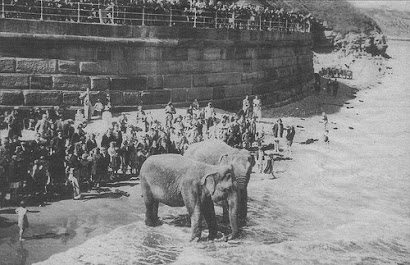
ELEPHANTS ON WHITBY BEACH

ELEPHANTS ON WHITBY BEACH

Friday, 16 September 2011

THE WALKING MEN

The ongoing battle to save Whitby's iconic piers demands that all of us realise what an incredible feat of engineering it took to build them.


Looking at these photographs taken in 1913 you could almost be forgiven for thinking that Whitby had been invaded by Martian machines, reminiscent of those found in H.G. Wells’ War Of The Worlds, whose sole aim would appear to be the destruction of the town.

But these ’Walking Men’ as the machines were colloquially known, were in fact here to build the east and west pier extensions, a necessary improvement which helped vessels trying to negotiate the sometimes treacherous harbour mouth.


Saturday, 10 September 2011

FLINT JACK: PRINCE OF COUNTERFEITERS

By Richard Locker


The Victorian era was an age teeming with heroes and villains, from an abundance of pioneers, inventers and forward thinkers, to the numerous ‘evil’ empires that sought to knock Great Britain from its imperial throne. Even the privileged and academic worlds of geology and archaeology had their share of good and bad from such luminaries as Charles Lyell and Lieutenant - General Augustus Henry Lane Fox Pitt Rivers right through to the villainous, like the infamous anti-hero Flint Jack (aka Jack Flint, Fossil Willy, Bones, Shirtless, Cockney Bill, the Old Antiquarian, Snake Billy, Skin and Grief).

Edward Simpson was born in 1815 in the village of Sleights. The family appeared unexceptional, his father been a sailor, and it was probably assumed that the young Edward would follow in his footstep when he eventually came of age. But his life was destined to take a different path when at the age of fourteen Edward became a servant to the local Geologist and Historian Dr George Young.

It seemed that this is where Edward learnt the rudiments of his trade as he followed Dr Young on his fossil - hunting expedition along the Yorkshire coastline. Some time later he left the services of Dr Young and took up with a Dr Ripley who was also a keen local historian.

After Dr Ripley’s death Edward ostensibly became an itinerant worker and it was on these tramps that he began to acquire his numerous aliases. At first he etched out a meagre living by gathering fossils found along the cliffs of Whitby and selling them to the local dealers. In 1841 he extended his ‘walks’ to include Scarborough, Filey and Bridlington, where he also became quite an expert in cleaning the fossils.

But it was on a return visit to Whitby when Edward met with a dubious character called Mr Dotchon, who showed Edward his first flint arrow head. Mr Dotchon went on to inquire if it was possible for Edward to replicate the arrow heads. Edward, fascinated by this questionable venture, decided to take up the proposition, and so it was that Flint Jack was born.

Replicating the fine workmanship of a genuine flint arrow head was a lot harder than Flint Jack had first imagined. In his despair Jack decided that however the Ancient Britons had crafted such tools had long been lost to antiquity, until one day when, purely be accident, he finally discovered a means of achieving the desired effect.

It was said that one morning whilst Jack puzzled over the intricacies of a flint arrow he became distracted by a damaged gate, he took off the hasp which was hanging loose and absentmindedly struck the ring against a piece of flint. To his astonishment off flew a fine flint flake and upon trying again and again he soon discovered he had found the perfect tool for his needs.

 
This was the defining moment that sent Flint Jack head long on his deceitful enterprise, along with flint tools he also set about reproducing British and Roman urns, which he manufactured first in Bridlington and then in a hut at Stainton Dale in the vicinity of Raven Hall, but possibly the most unscrupulous ‘find’ was ‘discovered’ in 1846 at Pickering, when he used an old tea tray to fashion a piece of armour. The Roman breast plate, he claimed, was unearthed at a site near Cawthorne camp on the outskirts of town. In fact he was so proud of his ‘discovery’ that when he had finished it he put it on and marched into the town of Malton, where he immediately found a buyer for the piece.

Jack eventually branched out and after teaming up with an art dealer named Block in Colchester move onto London, where Block acting as Jack’s agent set about selling the ‘finds’. It is no small credit to Flint Jack’s ingenuity and charisma that he was able to fool the establishment for so long . For not only did he pray upon the amateur Victorian collector he was also able to sell artefacts to museums and other serious collections across the country, including numerous pieces to the British Museum itself.


But in the end it seems that Flint Jack was his own worst enemy, as this passage from the Whitby Gazette at the time proclaims :-

It is to be regretted that a man so capable should be destined to waste his information among the occupants of the common lodging-house or the beer-house kitchen. On being asked recently, in Malton, what he would do if he was put into a hogshead of beer, he replied, “I would drink myself dry!”. Such is Flint Jack.

The following excerpt is a concise account of Flint Jack’s trial published in the Whitby Gazette on 19th March 1867

"Flint Jack" - A notorious Yorkshireman - one of the greatest impostors of our times -was last week sentenced to 12 months imprisonment for felony at Bedford. The prisoner gave the name of Edward Jackson, but his real name is Edward Simpson, of Sleights, Whitby, although he is equally well known as John Wilson, of Burlington, and Jerry Taylor, of Billery-dale, Yorkshire Moors. Probably no man is wider known than Simpson is under his aliases in various districts - viz. "Old Antiquarian", "Fossil Willy", "Bones", "Shirtless","Cockney Bill", and "Flint Jack", the latter name universally.

Under one or other of these designations Edward Simpson is known throughout England, Scotland and Ireland - in fact, wherever geologists or archaeologists resided, or wherever a museum was established, there did Flint Jack assuredly pass off his forged fossils and antiquities. 

He imbibed, however, a liking for drink, and he admits that from that cause his life for 20 years past has been one of great misery. To supply his cravings for liquor he set about the forging of both fossils and antiquities about 23 years ago.

In 1859, during one of his trips to London, Flint Jack was charged by Professor Tennant with the forgery of antiquities. He confessed, and was introduced on the platform of various societies, and exhibited the simple mode of his manufacture of spurious flints. From that time his trade became precarious, and Jack sunk deeper and deeper into habits of dissipation, until at length he became a thief, and was last week convicted on two counts and sent to prison for 12 months.
NORTH YORKSHIRE RAILWAYS: A SENTIMENTAL JOURNEY


This film, made by railway enthusiast Frank Dean in 1966, shows the last journey made along the Whitby to Scarborough railway line prior to it being dismantled in the devastating Beeching cuts. The narration is excellent and the music chosen surprisingly evocative and haunting.


The film largely speaks for itself, beginning with a man reading news of the line closures in a copy of the Whitby Gazette (when it was still a broadsheet) on Whitby Station. Frank and his wife Heather spent every weekend filming the Yorkshire lines scheduled to be axed by Dr Beeching's destructive purge.

Tagged onto the 1966 film is a section shot in 1967 in which contractors travel the length of the line stopping at stations along the way to gauge the value of railway property and see what can be sold for profit.


For people who may know the place well, at around 2.50 minutes is a view of the Whitby Gasworks with the gasometers still in place.

The film ends with the sad sight of workmen lifting the tracks of what must have been one of England's most beautiful stratches of railway.


More information on Frank Dean and his films at the Yorkshire Film Archive

Saturday, 11 June 2011

SUMMER BREAK


Unfortunately OUT ON YE! will be taking a short break until September. I need to do a study course for work which is going to take up quite a bit of time, so rather than publish rushed and poorly designed posts, I'm putting the blog on hold for a bit.

Don't panic though!

Regular contributor Richard Locker has just started his own blog Thoughts in Fits and Starts. Its brand spanking new and well worth a visit.

OUT ON YE! will be back in September. Until then, have a marvellous Summer.

Monday, 9 May 2011

THE OLD MULGRAVE CASTLE INN

By Richard Locker

The story of The Old Mulgrave Castle Inn, like numerous other public houses in Whitby, can now only be found amongst the pages of local history books. But right up until the year 1887 - when it eventually fell into the sea - this public house was perched atop the cliffs at Upgang on the outskirts of the town, where it commanded a domineering view of a large swathe of the coastline, from the town’s harbour mouth right up to the village of Sandsend and beyond, in fact it was the perfect position for an Inn who’s major concerns were largely disreputable.

Little is known of the origins of the pub, but it is thought to been serving ales as long ago as the 1700s, and of course it was also a well known hub for the local smuggling gangs, as was proved by an incident that occurred in 1817.

It was in this years that a particularly daring 'run' took place. Included in the cargo run were five hundred 'tubs' of gin. The 'Preventative Men' - who happened at the time to be in strong force in Whitby, having come over from Hull - heard of a 'landing' which had taken place somewhere to the north of the town. They duly searched the neighbourhood of Upgang.

After searching for a long time without finding anything, they were just about to give up in disgust when a stonemason noticed that a certain stone in a retaining wall appeared to have recently been disturbed. He called the attention of the Preventative Men to this and, upon removal of the stone the searchers found a huge store of two hundred tubs, which were removed to Whitby in carts and wagons. The men in charge of the wagons were, as usual, in sympathy with the smugglers and ’lost’ more than a few of their tubs on their way into town.

A mounting blocking found in the vicinity of Upgang, possibly all that
remains of the Inn

When in Sandgate, a linchpin of one of the wagons was conveniently removed and the cumbersome vehicle upset, bursting a good number of the tubs of gin. The liquor ran into the gutters of the street, and was eagerly scooped up by the large crowd which had been drawn out of doors at the news of the capture. Those who found themselves at a loss for a scoop took off their boots and used these. Altogether a sad day for the local ’Pussyfoots.’

The following day, the Preventative Men renewed their search at Upgang, but without results, as the rest, and far the larger part of the cargo, had been removed during the night, with an audacity which deserved success. Nearly two hundred tubs were placed aboard a fishing boat, one of the Staithes 'yacker' type, and the vessel was actually brought into Whitby harbour and laid up on Bell Island 'for repairs', during the progress of which the incriminating cargo was quietly removed.
Account taken from Shaw Jeffrey’s ‘Whitby Lore and Legend’.

It seems that the Inn carried on with it’s risky business regardless of the probable close scrutiny the 1817 event would have incurred. The only other mention of a brush with the law was in 1860, when the then licensee a Mr Cornforth was charged with opening his house for the sale of drink before half past twelve on Sunday. After been cautioned he was ordered to pay costs, along with a Mr Thomas Pattison of the White House, who was also summoned on the same charge.

Mr Cornforth was in fact the last tenant of the Old Mulgrave Castle Inn as in the August of 1885 the justice refused to renew the Inn’s licence, because of the building‘s situation, which was by then was dangerously close to the edge of the cliff.

The area where the inn was situated, now part of Whitby golf course

Monday, 2 May 2011

BACK UP HOME: A TALE OF JIGSAWS, NARROW ALLEYS AND BOAT GNOMES

Text and pictures: Rachel Cockett

Born and bought up in Whitby. I live in Worcestershire and work in a museum in Birmingham. I recently went back up home to see my parents and to visit the places of my childhood. I met old friends, new friends, mysterious characters and at least one invisible little man.


Might it be the home of Elphi the hob? For the price of some daily bread, creamy milk and cheese Elphi keeps the museum clean and tidy. This video tells the story of what happened at Ryedale when the bad curator (who didn’t believe in Elphi) took charge.


ANOTHER DAY, ANOTHER MUSEUM
Captain Cook & Staithes Heritage Centre. A member of the Association of Independent Museums (AIM), NEVER has the word *independent* been more appropriately applied.


AND FINALLY...No visit back up home is complete without popping in to Whitby Museum. Home to the Hand of Glory and the Tempest Prognosticator (a Leech Barometer , but you knew that). My new favourite object is Sea Bishop, “made by fisherman for sale to gullible visitors”, a tiny preaching bishop formed from dried fishy bits, complete with mitre and…tail.

Saturday, 16 April 2011

DRACULA 1977

By Richard Locker

When Bram Stoker’s novel Dracula first appeared in 1897 it was regarded by the Victorian reading public as just another fantastical ‘invasion’ story, similar in vein to H.G Wells’ War Of The Worlds. It wouldn’t be until the 20th century when the book began to be adapted for the screen, that the story of the Count would attain it’s legendary status and the town of Whitby would forever become inextricably linked with the demon vampire.


Although Whitby is intrinsic to the story both Hollywood and the British Hammer Horror films seemed to disregard this fact, either opting for shooting in alternative locations around the UK, (in Hammer’s case usually for budgetary reasons), or as would happen in some movies the town was simply ignored and the arrival of the Count transposed directly to London (Francis Ford Coppola’s Dracula is one such film).

In fact it wasn’t until 1977 when the BBC commissioned a three part mini series based on the novel, that the town was used for the actual scenes set in Whitby.


This BBC adaptation of the book is now considered by both critics and fans alike to be the most faithful. The film historian Stuart Gailbrath IV said that ‘Count Dracula remains one of the best-ever adaptations of Bram Stoker’s novel’ despite a ‘couple of missteps’, remarking that ’the cast is excellent’, in particular praising the performance of Frank Finlay (Van Helsing) and Louis Jordan (Count Dracula), who he calls especially good.

 The critic Steve Calvert agreed that Count Dracula was ‘one of the better versions’ of Stoker’s novel, calling it ‘perhaps even the best.’ he felt that ’few actors have ever played the role of Van Helsing as convincingly’ as Frank Finlay, that ‘without doubt, Jack Shepherd is the best on-screen embodiment there as ever been of the fly munching Renfield’, and remarked of Jourdan’s performance, ‘(His) Dracula …. exudes a quieter kind of evil. A calculating, educated evil with a confidence and purpose all of it’s own.’


Of course the intervening years have not been kind to certain aspects of the film, it could be said that some of the special effects are rudimentary to say the least. But the direction, editing, sound and visual imagery are all used to powerful effect and make for an unsettling experience, relying more on a subtle sense of dread, rather than the usual blood letting that is often associated with other versions of the story.

Some of the more memorable scenes look almost experimental in style, with a strange surrealist quality about them. Even the fact that the external scenes are all shot in film and the interiors on video only seems to add to the feeling of oddness that is suffused throughout the film.

Friday, 15 April 2011

MAYBECK SPRING FLOWERS

...

Lesser Celandine

Wood Anemone

Primrose

Thursday, 14 April 2011

THE FATEFUL 1816 VOYAGE OF THE ESK

William Scoresby
The 1816 voyage of the Esk to Spitzbergen under the command of Captain William Scoresby proved a most disastrous endeavour. As soon as the ship crossed into the arctic ice fields, a storm of such ferocity bore down on the vessel that Scoresby, a veteran of fourteen voyages, considered the hazardous situation the worst he had ever encountered. The storm lasted a full twelve hours, a prolonged period throughout which the crew must have felt in sickeningly close proximity to certain death and destruction.

After trying several times to free the Esk from the ever encroaching ice, which involved the intricate navigation of an unwieldy, cumbersome ship through narrow channels between drifting floes, on May 2nd open water was acheived.

Until June 19th the Esk was employed in the activity for which she was built, namely the hunting of whales. Although not the best season ever, a reasonable amount of 'fish' were caught. Things were going tolerably to plan, but in such an inhospitable environment nothing can be taken for granted.

In an attempt to avoid being crushed by two massive ice floes which were inexorably coming together, the Esk was steered towards an indentation in the ice. The thought was that, although it would be fairly tight, when the blocks of ice came together the indentation would prevent the Esk from being broken like a wallnut in a nutcracker.


Unfortunately, and unbeknown to the crew, a submerged projection of ice known as a tongue had done severe damage below the water. When the pressure of the opposed masses relaxed, the ship began to sink.

A distress signal was immediately sent out and assistance came from many of the ships busy in the area. One was the John of Greenock, commanded by Mr Jackson, Scoresby's brother-in-law. With the extra manpower available, pumps and buckets were put to constant use until the extent of the damage was ascertained.

Water was welling into the ship through a large hole due to a major section of the after keel being torn away. Emergency measures to save the Esk were discussed. Several plans were put forward. In the end it was decided to adopt the most extraordinary proposition of all.

The rigging was taken down and all portable stores and furniture were removed from the stricken ship and placed on the ice. Ropes were tied to the tops of the masts and heavy anchors were suspended from them to aid rotation of the ship. These ropes went under the hull of the vessel and onto the ice where they would be heaved upon by as many men as possible, the idea being to turn the Esk upside down in the water so the carpenter could then climb aboard the upturned hull and make good a repair

The attempt to capsize the arctic whaling ship the Esk by running ropes beneath her and using heavy anchors to assist in the manouvre. Click on the picture for a larger image.
With one hundred and fifty men pulling, the ship still refused to careen sufficiently and it was obvious that some extra persuasion was required. Scoresby duly went on board with one hundred and twenty men who lined up at the highest side of the tilted deck, and then ran en masse to the lower side in a vain attempt to suddenly move the ship in the water. Sadly all these endeavours failed and it was back to the drawing board.

In the end a plan to partition and seal off the injured part of the ship was hatched. This was carried out successfully and swiftly. The repair was tightly caulked to prevent leakage, and a 'thrumbed' sail - that is to say a sail studded with bunches of oakum and rope yarn - was applied to the hole externally. This was sucked into the leak by water pressure and served to partially choke the influx.

On July 6th 1816 the Esk set sail for home. The John remained with her to chaperone the limping vessel back to England. Because he had forgone any chance of success in the whale fishery through the unstinting assistance he'd given to Scoresby and his crew, Captain Jackson agreed a pact. He would take half of the cargo captured by the Esk prior to her near fatal accident.

On July 27th the Esk entered Whitby harbour with all but one of the crew she set out with, and all in a reasonable state of health. In the words of Captain William Scoresby...

The hearty congratulations I received on landing, from every acquaintance, were almost overwhelming, and these, with the enhanced endearments of my affectionate and enraptured wife, amply repaid me for all the toils and anxieties of mind that I had endured.

Saturday, 9 April 2011

CIVIL WAR, ALUM AND THE DEMONIACKS


Old Mulgrave Castle

Captain Zachary Steward was born in 1607. The Steward family owned the estate of Lofthouse in Yorkshire, now Loftus, Cleveland. His father was Dr Zachary Steward, Rector of Easington, Fellow of Queen's College, Cambridge and Chaplain to the Archbishop of York. The Stewards of Loftus descended from the Stewards of Ely, Cambridgeshire, who claimed both the royal Stewarts and Oliver Cromwell among their relations. Dr Steward's second cousin, Elizabeth, was Cromwell's mother.

Captain Steward was in his mid-30s when the English Civil War (1642-1651) came to this corner of Yorkshire. A Royalist, he garrisoned Mulgrave Castle for Charles I and became governor of the ancient stronghold, the ruins of which can still be found deep within Mulgrave Woods, near Lythe. In July 1644, following the Battle of Marston Moor, Colonel Francis Boynton came north to reclaim the castle for Parliament. The rendition seems to have happened without bloodshed, an agreement having been made between the two sides. Captain Steward was allowed to ride out of the gates at the head of his men, drums beating, colours flying, having left all arms and ammunition behind. Mulgrave Castle was dismantled by Parliament in 1647, possibly by means of gunpowder, and has been in ruins ever since. Captain Steward had ensured his own house and lands at nearby Loftus were not forfeited. A condition of his freedom was an undertaking that he would be involved in no further hostility towards Parliament.

Steward subsequently made a great fortune through the discovery of alum on his land. He had founded, and owned, the profitable Loftus alum works. His only child, a daughter named Mary, married a Thomas Moore. Their son, Zachary Steward-Moore, inherited the Steward's vast wealth and lived in a large house sited where the supermarket now stands in Loftus Market Place. A flamboyant 18th century hell-raiser, Steward-Moore seems to have been a popular and fashionable man about town. He was a prominent member of the Demoniacks, the North Riding version of the Hell Fire Club. This secret society, founded in the 1740s by John "Crazy" Hall Stevenson, "indulged by night in heavy drinking and obscene jesting". The Demoniacks were based at Stevenson's home in the then rambling medieval castle at Skelton. It gained the name "Crazy Castle", no doubt their nocturnal activities hadn't gone unnoticed in the locality. A fellow Demoniack was Laurence Sterne, author of Tristram Shandy, and it is quite possible that some of the characters in the novel were inspired by his friends at Skelton. The actor, David Garrick, was another visitor.


Old Skelton Castle

Zachary Steward-Moore was said to have shod his horses hooves with silver and kept company with those who, "assisted him in the laborious work of getting to the far end of a great fortune." John Hall Stevenson wrote the following verse about Moore in his "Crazy Tales":

"What sober heads hast thou made ache!
How many hast thou kept from nodding!
How many wise ones, for thy sake,
Have flown to thee, and left off plodding!
Philosophy and grace are thine,
Not spiritual grace but sprightly;
Inspired by the god of wine,
Inspired like old Anacreon nightly.
Whether thy grace from heaven descends,
Or rises from the earth below,
Oft hast thou raised thy helpless friends,
Oft given thy purse unto thy foe."

Inevitably, Zachary Steward-Moore squandered all his family's money. As his funds dwindled, so did the number of his friends. He saw out the rest of his days in relative modesty at Gibraltar when offered a Lieutenancy there by one of his more loyal former acquaintances.

By Chris Corner.