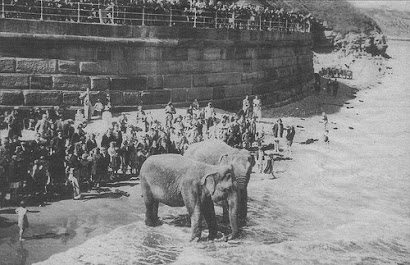
ELEPHANTS ON WHITBY BEACH

ELEPHANTS ON WHITBY BEACH

Monday, 19 July 2010

COMMON GREY SEA SLUG


The eggs of Aeolidia papillosa
...
Last summer I was surprised to discover the eggs of the Common Grey Sea Slug (Aeolidia papillosa) under a stone at Sandsend. This year on the 2nd of July I scrambled down the cliff at Kettleness for a spot of rockpooling in the beautiful pools there on a baking Summer's day.

Once again, under a stone on the middle shore was an example of one of the characteristically spiral shaped egg masses of this fascinating creature. Normally living in much deeper water, these sea slugs come up the shore every year in July and August to spawn.

This time, under another rock I was lucky enough to find one of these elusive, beautiful sea slugs. It was only partially covered with water in its original position, but once placed on a flat stone in a clear pool it could be seen in all its glory.

Aeolidia papillosa

They feed on sea anemones and can actually use the undischarged stinging cells (nematocysts) of the anemones they've eaten. The stinging cells pass undigested into the tips of the projections, known as cerata, that cover the surface of the sea slug helping to protect it from predators. An effective defence mechanism is vital in a creature whose shell has been lost through evolution

Although known as the Common Grey Sea Slug, the colour of the animals vary according to their local food supply, in this case the red sea anenomes on which it feeds have given it a rosy tinge. They can grow to 120mm in length, although this specimen is much smaller.

Against a £1 coin as a size comparison

Sunday, 11 July 2010

THE PROSPECT OF WHITBY

Written and illustrated by Richard Locker
...


The Prospect Of Whitby is thought to be the oldest surviving public house in London, it can be found to the east of the city centre on the banks of the river Thames at Wapping. Situated within the borough of Tower Hamlets and surrounded by the infamous London Docklands, the pub has what could be considered a long and colourful history.

First built around 1520 during the reign of Henry VIII, the pub’s official name was ’The Pelican’, but as the river commerce increased a more transient population appeared tarnishing the riverside tavern with a dubious reputation. Finding itself host to a nefarious clientele made up of sailors, smugglers, prostitutes, cut throats and footpads the pub would eventually be re-christened the ‘Devils Tavern’ in their honour.

The Prospect of Whitby circa 1890

Perhaps the most villainous of the pub’s patrons was the 17th century nobleman ‘Hanging’ Judge Jeffreys. Known as the scourge of the Monmouth Rebellion, he was responsible for the putting to death of over 320 rebel supporters and sentencing a further 800 for transportation to the West Indies.

It was said that the Judge’s visits to the Devil’s Tavern would usually coincide with the hanging of local criminals at Execution Dock. He also enjoyed watching terrified felons being tied to posts on the river bank and left there whilst several tides washed over them. The scene is made all the more macabre by the fact that he was probably the very judge involved in sentencing these people to death.

Hanging Judge Jeffreys

Not all the pub’s customers were monsters, the famous writer and diarist Samuel Pepys was known to have frequented the establishment, although this was probably for no other reason than to carry out his numerous extra marital affairs in what he might have considered relative secrecy. He would often recount these infidelities in his diaries, as well as making several remarks about disturbances caused by the sailors in the Wapping area.

In 1777, after the Devil’s Tavern had been rebuilt because of damage sustained during a devastating fire, the landlord decided to rename the inn ’The Prospect Of Whitby’ after a square rigged collier called ‘The Prospect’. Built and registered in Whitby, the ship would often be found moored up outside the tavern after delivering it’s intended shipment of coal from the North-Eastern coal fields of County Durham and Newcastle.

In fact the ship became so much of a landmark, that the local people began referring to the pub as ’the one by the Prospect Of Whitby’. So like the Devil’s Tavern before it the name remained, right up until the present day where it is still possible to venture down to the banks of the Thames and buy yourself a pint in what is still considered to be the oldest pub in London.

A victim of The Judge

Thursday, 24 June 2010

SAND SHOES

20:06:10
Abandoned shoes created by artist Viv Mousdell examining the mutability of sand and time in an installation by the beach huts , Whitby.

'Even castles made from sand fall to the ocean'
Jimi Hendrix
...

Simon Verhoef populates the beach with phantom footwear. Their advance and reclaimation by the sea is being documented with time lapse photography.

Links:

Saturday, 19 June 2010

CAPTAIN SLEET

BY RICHARD LOCKER
...
Herman Melville

'There is no life in thee, now, except that rocking life imparted by a gentle rolling ship; by her, borrowed from the sea, by the sea, from the inscrutable tides of God. But while this sleep, this dream is on ye, move your foot or hand an inch; slip your hold at all; and your identity comes back in horror.'
From The Mast Head , chapter 35 of the novel Moby Dick by Herman Melville.

An extract from Moby Dick relating to Captain Sleet
...
Herman Melville’s Moby Dick is considered to be a masterpiece of modern literature, written in a distinctly modernist style, it uses symbolism and metaphor to tell what appears to be a simple story of a young mariner called Ishmael and his adventures aboard the Pequod, a whaling ship captained by the tyrannical Ahab.

The book itself is epic in scale encompassing a vast array of themes, including Melville’s personal beliefs on the concepts of class and social status, good and evil, man’s place in the natural order of things, religion and the existence of God.

But this strange tale of one man’s vengeful battle against nature can also be viewed as a rather unorthodox whaling manual, with a variety of chapters about different whale species, including an in-depth analysis of the sperm whale and its secretive behaviour.
...

A sailor on duty at the Mast Head

There are also large sections of the book concerned with shipboard etiquette and the mechanics of the whale hunt. One such chapter is ‘The Mast Head’ which deals with the art of standing atop the ship’s t’gallant-mast on two thin parallel sticks called the t’gallant cross trees, where it was the sailor’s duty to keep a look out for any sign of the whale.

Melville goes on to describe in great detail a romantic history of the Mast Head and the fact that it has been irrevocably altered by the invention of the ‘crow’s nest’ by the Greenland whaler called Captain Sleet - it seems that the author is having fun at the expense of the Greenland whalers and the extreme weather conditions they had to endure, because when he refers to Captain Sleet he is in actual fact talking about the real inventor of the crow’s nest William Scoresby Senior.
Later in the chapter Melville admits to a secret admiration for William Scoresby and his crow’s nest, but still he adheres to the fact that an aspect of seamanship had gone forever. He considers that the endless hours, days and months spend atop the ship’s mast, with nothing but the vast sprawling ocean below and a sailor’s wild romantic thoughts for company, would be all but lost to the poor soul hidden inside the closetted confines of Sleet’s crow’s nest.

'Heed it well, you pantheists!'

STILL LIFE


Barnacles and limpets are a common sight on any of the rocks around Whitby, and you could be forgiven for thinking that the two creatures are somehow related. Indeed for a long time naturalists classified both as molluscs, along with the whelks, mussels, cockles and winkles familiar from seafood stalls.

Its true that both barnacles and limpets are apparently sessile, that is to say they don't move much, and both have similar shaped shells. However in 1830 an army surgeon called J. V. Thompson published a paper snappily entitled On the cirripedes or barnacles; demonstrating their deceptive character; the extraordinary metamorphosis they undergo, and the class of animals to which they undisputably belong.

Thompson, who was an amateur naturalist by inclination, examined the life cycle of banacles and discovered that they had a planktonic larval stage called a nauplius exactly like that of a crab or lobster. The nauplius then went though transformation into another unique stage known as a cyprid.

Thompson found that the non-feeding cyprid had the job of finding a suitable rock or shell on which to settle and spend the rest of its adult life. Once a desirable location was found, the cyprid would cement itself to the surface with its attachment antennae and then form calcified plates around its body becoming a fully formed young barnacle.


Thompson's dilligent work placed the barnacles once and for all alongside the crabs, lobsters, shrimps and prawns in the class Crustacea.

In effect they glue their heads to a rock, build a protective casing around themselves with a door in the top, stick their legs (cirri) out and waft water containing tiny items of planktonic food into their mouths.

This is known as cirral beating, but you have to creep up very quietly to see it in action. Once there is a slight hint of vibration, or once a shadow is cast over the rockpool, the cirri immediately contract back into the safety of the shell in the blink of an eye.


The picture below shows several examples of the common cirripede Semibalanus balanoides on a Sandsend rock. As well as the adults there are plenty of youngsters with much smaller shells which are approximately a month or so old.

Also I've ringed a couple of 1-2 week old light brown post-larval individuals. These are just transforming from cyprid larvae into fully fledged barnacles, but have not yet become calcified.

Saturday, 5 June 2010

THE BATTLE OF BANNIAL FLATT

...
BY RICHARD LOCKER
...

It was a cold, snow covered morning on the 3rd February 1940, when the crew of the impressively large Radar station situated at Danby Beacon located and confirmed the presence of enemy bombers patrolling the seas off the North East coast of England.

The information was immediately relayed to the only airfield not snowbound that morning at Acklington in Northumberland, which was home to Flight Lieutenant Peter Townsend and the 43 Squadron. Once alerted to the imminent danger a section from B flight was dispatched to intercept the enemy force.

RAF Danby Beacon radar station as it looked in 1940
Flight Lieutenant Townsend and B flight eventually made contact with the Germans just off the coast at Whitby. The enemy plane sighted was a Heinkel III (a slow moving German bomber), which had been part of a bigger operation that day, its objective was to locate and destroy British shipping in the North Sea.The German plane stood little chance as the three British Hawker Hurricanes swarmed around it. Shot to pieces, the Heinkel limped on, desperate to escape the British onslaught.

The bomber, now out of control and losing altitude, made for land, and so it was that the town of Whitby awoke that morning to a dreadful sound as the damaged plane screeched over its roof tops.
The bomber finally crashed on the outskirts of town at Bannial Flatt, narrowly missing the farm house that stood there. Tragically two of the aircrew Rudolf Leuchake (observer) and Johann Meyer (flight engineer and ventral gunner) were killed in the attack. Of the two remaining airmen Unter Offizer Herman Wilms (pilot) survived and Karl Missy (radio operator and dorsal gunner) received severe wounds.

Then Flight Lieutenant Peter Townsend

The pilot having managed to free himself as well as being able to burn the official flight documents, tried to make good his escape, but was quickly apprehended by George Walker a postal worker who having seen the plane crash had been one of the first arrive on the scene. His Great Granddaughter Anna Welford would later recount George’s version of that mornings events:

“The pilot then gave himself up, however my Great Grandad and the other witnesses did not realise that the German was carrying a gun, luckily no harm came to him or the other witnesses.

As soon as the situation was under control my Great Grandad had to resume his postal duties…..all in day’s work”

A second witness, Roy Steele a ten year old boy from Hawsker, had been helping his Grandfather on the farm that morning when he happened to hear machine gun fire, looking up he saw the approach of the damaged bomber seconds before it crashed into the farm yard.

Quickly coming to the aid of the crash victims the boy was told by his Grandfather to climb into the wreckage and free the gunner who had been trapped in the rear of the plane. Both the surviving airmen were then unceremoniously locked in the farm’s coal house, where they stayed until Special Constable Arthur Barrett arrived with reinforcements.

Upon discovering the outcome of the attack Flight Lieutenant Peter Townsend along with two other pilots went to visit the survivors of the crash in hospital, bringing with them gifts of fruit, cigarettes and a sense of camaraderie for men, who like themselves, faced their fate every time they took to the air. The dead German crewmen were buried with full military honours at Catterick. A wreath was placed on their coffins, with a card that read 'From 43 Squadron with sympathy'.

The crashed Heinkel at Bannial Flatt farm

It would later emerge that this was in fact the first enemy plane to be shot down over England since World War One, but the significance of the bravery, heroism and tragedy of that day would somehow be lost as the war years continued to grind on and the subsequent death toll reached overwhelming proportions.

Friday, 4 June 2010

RADIO CAEDMON


On the 30th of May, BBC Radio 4's Poetry Please featured Liverpool poet Roger McGough investigating the wealth of poetry manuscripts held by Cambridge University Library.

Among these was the Moore Bede, an early manuscript of The Venerable Bede's Historia ecclesiastica gentis Anglorum ( Ecclesiastical History of the English People). It was donated to the library by George I who purchased it from Bishop John Moore (1646-1714).

Caedmon's Hymn as it appears in the Moore Bede

Dated to the eighth century, it cosists of 128 pages. The final page contains a version known as the Northumbrian aelda recension of Caedmon's Hymn, thought to be the earliest occurrence of the poem.

Here is a short clip of the programme in which, after a brief introduction, the poem is firstly read in Anglo Saxon with its rich rhythms and characteristic consonants, and then offered in a modern translation read by the actress Juliet Stevenson

Sunday, 23 May 2010

TWO FEMALE SAILORS

'Two or three years ago there was a great run on female sailors. Every newspaper has its paragraph announcing the discovery of a female sailor. The result was a through conviction in the public mind that all sailors were female sailors - that there were no other sailors than female sailors in disguise; and now the curiosity would be the discovery of a male sailor, if such a phenomenon could be well authenticated.'From The Examiner, 25th March 1843.


MARIANNE REBECCA JOHNSON

In 1807 a Master Bricklayer working in Bishopsgate, London saw what he thought was a sailor boy sitting in a doorway in a very sorry state. The youth was drenched with rain, shivering with cold and weeping inconsolably.

The man questioned the boy on his situation and discovered that he had run away from a northern coal ship, now in Pool, on which he had served a four year apprenticeship. He avowed that he would rather face the hangman's noose than return on board.

The pair went to The Bull's Head for rest and refreshment, but on entering the inn the lad fainted through fatigue and hunger upon the stone floor. On loosening his neck-handkerchief and opening his shirt to aid resuscitation, the sailor's true sex became apparent.

The hostess of The Black Bull took the girl under her benevolent wing, displaying great understanding and kindness. At length the following narrative emerged:

She was a native of Whitby named Marianne Rebecca Johnson whose Father had died in the service of his country. Her Mother remarried another man and the family continued to live in Whitby. One day whilst at work in the town, her Stepfather took her away and forced her to don sailor's attire. He threatened to murder her if she ever disclosed her true sex, and he bound her up as an apprentice on the coal ship Mayflower of Sunderland, on which she served for four years without her true gender ever coming to light. She was known as William Johnson.

On the Monday prior to her discovery, she was ill and in a very delicate situation. Thinking her lazy and insolent, the mate had her severely flogged. On the Tuesday morning with cunning and determination she made good her escape.

It turned out that the girl's Father had treated her Mother in a similar way. She too had been forced into sailor's clothes, and with her hair cropped enrolled on board a ship of war .

She served for seven years before being mortally wounded in the late taking of Copenhagen(August 16th-September 5th 1807). A letter written just before her death to a friend in Whitby made clear the circumstances of her fate. She clearly preferred the hardship of a life at sea to the chance of ever meeting her brutal husband again.

Marianne Rebecca Johnson was just seventeen.


The Cabin Boy by Ralph Hedley 1891


THOMAS STEWART

One day in 1860 a jolly looking sailor boy calling himself Thomas Stewart took lodgings in the Royal Princess Inn, Church Street, Whitby. Several other seamen were in the bar and the drinks were flowing freely, as they do on such occasions. As the night wore on, being suitably inebriated and in pleasant company, he began to display his unusual vocal prowess.

It was all going well until the party spilled out onto Church Street. A passing police constable noticed that the lad's voice and appearance betrayed a certain feminine quality.

The constable accompanied the sailor to his lodgings, and the landlady confirmed that there were good grounds for suspicion. Being drunk and extremely foul mouthed, the sailor was locked in a cell overnight. In the morning a doctor confirmed the diagnosis.

The girl claimed to be a native of Glasgow whose Mother was dead and whose Father had drowned at sea. Having four sailor brothers, at the age of twelve she too decided on a career at sea. She enrolled on a ship bound for Australia. For five years she followed her chosen occupation, her last voyage being aboard The Morning Star.

She was brought before the Magistrate, who noted the blackness of her teeth from smoking and chewing tobacco, and her comprehensive seafaring knowledge. She was keen to obtain another voyage of eighteen months. She thought then she would have saved enough to purchase some petticoats and follow a calling more becoming of a female.

It was recommended that she was seen safely out of town and given 3 shillings out of the box. However she was reported drunk again the same evening at Upgang, and likewise the following day at Hinderwell.

She too was seventeen years of age.


A group of 19th century sailors

Thanks to Richard Locker for research and ideas.
Thursday, 13 May 2010

THE PENNY HEDGE

On Rogation Wednesday, the eve of Ascention Day, the Penny Hedge or Horngarth is planted on the shore of Whitby harbour. Despite the commonly recited story of the three noblemen chasing a wild boar into a hermit's cell, killing the hermit and being required to build the hedge as pennance, the true origin of the ceremony is lost in the mists of time.

At sunrise stakes cut from hazel on Eskdaleside, using a knife bought for a penny, are carried through the town to the designated place in the harbour. The hedge should be constructed well enough to withstand three tides, however in 1981 the site was covered by eight feet of seawater and a hedge was not built thereby rightfully ending the pennance.

Nevertheless the ceremony continues. Here is a video of this year's Horngarth ritual at 9am on a sunny and pleasantly breezy Ascention Eve.


Saturday, 8 May 2010

ARTHUR MACHEN

“I saw the wonder of the town in the light of the afterglow that was red in the west. The clouds blossomed into rose-gardens; there were seas of fairy green that swam about isle of crimson light; there were clouds like spears of flame, like dragons of fire. And under the mingling lights and colours of such a sky Banwick went down to the pools of it’s land locked harbour and climbed again across the bridge towards the ruined abbey and the great church on the hill”

The Happy Children

The Welsh author Arthur Machen (1863-1947) is best known as a writer of supernatural and horror fiction. A contemporary of Bram Stoker and Oscar Wilde he also influenced the likes of H. P. Lovecraft, Stephen King and Alan Moore. His most famous books include The Great God Pan (1894), The Three Impostors (1895) and The Hill Of Dreams (1907), but it was his work as a journalist for the London paper The Evening News that would lead him to visit Whitby in November 1916.

The visit was arranged ostensibly for Machen to write an article on the town’s resurgent jet industry, which had seen a revival due to the wartime fashion for wearing mourning jewellery. But what really fascinated him was the town itself, regarding it as beautiful and unspoilt, he would later compare it favourably to seeing the view of Avignon from Rhone; ‘It was wonderful, but I do not know it more wonderful than Whitby as I saw it a few days ago’. It was this enthusiasm for the place that inspired him to writing the short story ‘The Happy Children’.
...

The Happy Children is a ghostly tale set in the town of Banwick, and like all Machen’s war time fiction it is a propaganda piece designed to appeal to the nation’s jingoistic mood at the time. However, unlike his most famous wartime piece ‘The Bowmen’ (a story about invoking the spirit of St George and the Agincourt archer on the blood drenched battlefields of Belgium), The Happy Children is a much more subtle story, involving such wartime tragedies as the sinking of the Lusitania and the believed atrocities committed by the German army in France and Belgium.

Machen would also have been aware that Whitby had suffered it’s own atrocities two years earlier, when it was bombarded along with Scarborough and Hartlepool by two German destroyers, killing 137 people and injuring a further 592.
...
As was usual for Machen’s writing, the story also has a strong religious undercurrent, referring to the Biblical slaughter of babies by Herod as is celebrated in the feast of Holy Innocents. But what is more prevalent in this piece is Machen’s own personal belief system, which together with detailed and evocative descriptions of nature and the landscape, conjures up a seemingly more magical and ancient time.


Throughout the First World War Arthur Machen was a patriot giving his full support to the war in Europe, believing that the Allied forces were fighting a just war against the evil German Empire. He was less forthcoming with his praise when it came to the battle for hearts and minds back in England though, especially after the publication of The Bowmen and the resultant ‘Angels Of Mons’ myth.

What becomes more apparent with stories like The Happy Children is that his writing takes on a more serene quality, as if Machen himself having become increasingly distressed by the utter devastation the war was causing, wants to escape along with the war’s innocent victims into a more peaceful place.

Read The Happy Children by Arthur Machen here

Written exclusively for OUT ON YE! by RICHARD LOCKER.
Thanks to Gwilym Games and Chris Corner for all their help.