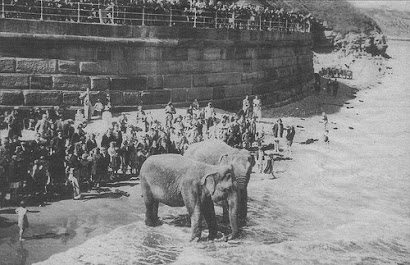
ELEPHANTS ON WHITBY BEACH

ELEPHANTS ON WHITBY BEACH

Saturday, 8 May 2010

ARTHUR MACHEN

“I saw the wonder of the town in the light of the afterglow that was red in the west. The clouds blossomed into rose-gardens; there were seas of fairy green that swam about isle of crimson light; there were clouds like spears of flame, like dragons of fire. And under the mingling lights and colours of such a sky Banwick went down to the pools of it’s land locked harbour and climbed again across the bridge towards the ruined abbey and the great church on the hill”

The Happy Children

The Welsh author Arthur Machen (1863-1947) is best known as a writer of supernatural and horror fiction. A contemporary of Bram Stoker and Oscar Wilde he also influenced the likes of H. P. Lovecraft, Stephen King and Alan Moore. His most famous books include The Great God Pan (1894), The Three Impostors (1895) and The Hill Of Dreams (1907), but it was his work as a journalist for the London paper The Evening News that would lead him to visit Whitby in November 1916.

The visit was arranged ostensibly for Machen to write an article on the town’s resurgent jet industry, which had seen a revival due to the wartime fashion for wearing mourning jewellery. But what really fascinated him was the town itself, regarding it as beautiful and unspoilt, he would later compare it favourably to seeing the view of Avignon from Rhone; ‘It was wonderful, but I do not know it more wonderful than Whitby as I saw it a few days ago’. It was this enthusiasm for the place that inspired him to writing the short story ‘The Happy Children’.
...

The Happy Children is a ghostly tale set in the town of Banwick, and like all Machen’s war time fiction it is a propaganda piece designed to appeal to the nation’s jingoistic mood at the time. However, unlike his most famous wartime piece ‘The Bowmen’ (a story about invoking the spirit of St George and the Agincourt archer on the blood drenched battlefields of Belgium), The Happy Children is a much more subtle story, involving such wartime tragedies as the sinking of the Lusitania and the believed atrocities committed by the German army in France and Belgium.

Machen would also have been aware that Whitby had suffered it’s own atrocities two years earlier, when it was bombarded along with Scarborough and Hartlepool by two German destroyers, killing 137 people and injuring a further 592.
...
As was usual for Machen’s writing, the story also has a strong religious undercurrent, referring to the Biblical slaughter of babies by Herod as is celebrated in the feast of Holy Innocents. But what is more prevalent in this piece is Machen’s own personal belief system, which together with detailed and evocative descriptions of nature and the landscape, conjures up a seemingly more magical and ancient time.


Throughout the First World War Arthur Machen was a patriot giving his full support to the war in Europe, believing that the Allied forces were fighting a just war against the evil German Empire. He was less forthcoming with his praise when it came to the battle for hearts and minds back in England though, especially after the publication of The Bowmen and the resultant ‘Angels Of Mons’ myth.

What becomes more apparent with stories like The Happy Children is that his writing takes on a more serene quality, as if Machen himself having become increasingly distressed by the utter devastation the war was causing, wants to escape along with the war’s innocent victims into a more peaceful place.

Read The Happy Children by Arthur Machen here

Written exclusively for OUT ON YE! by RICHARD LOCKER.
Thanks to Gwilym Games and Chris Corner for all their help.

Wednesday, 21 April 2010

THE WHITBY MOLE

Sir Hugh Cholmley was one of Whitby’s greatest benefactors, helping to completely redefine the town in the early 17th century. In 1632 he was charged with building a stone pier at the mouth of the harbour. A necessary improvement which enabled the town to accommodate the new alum mining industry and the subsequent increase in shipping it brought.

Upon completion of the pier, Sir Hugh Cholmley found that his engineering skills had been noted and held in the highest regard, eventually winning him a royal commission to build a gigantic Mole (a defensive harbour wall) in Tangier.

Up until 1661 the sea port of Tangier in Morocco had been under the rule of the Portuguese, but was ceded to England as part of the dowry of Catherine of Braganza on her marriage to Charles II.

Sir Hugh Cholmley arrived in Tangier in June 1663, bringing with him 'about 40 masons, miners and other proper artists and workmen'. Apparently it was with considerable persuasion that he had managed to attract these artisans, because it was ‘a place where, in the beginning, so many men had died’.

Work on the foundations began in the August 1663, but immediately the project was beset by a number of problems. The main one being that the cost of the project had been considerably underestimated. Cholmely decided to source the building material from a nearby quarry, which was immediately christened 'Whitby' by the Yorkshire miners. As the project continued Cholmely built ‘a little town’ at Whitby to house the workmen and their families, with stabling for ninety horses, storehouses for provisions and materials of all sorts'.
...

A plan of Tangier from an engraving by I. Seller dated 1680. The area named Whitby is highlighted in yellow.

When eventually the Mole was finished in 1676, it was described as ‘in its design the greatest and most noble undertaking in the world’ and was said to be 'now near 470 yards long and 30 yards broad, with several pretty houses upon it and many families. On the inner side twenty four Arched Cellars and before them a curious walk, with pillars for mooring of ships'. Also housed on the Mole was a vast array of guns readied for the port’s defence.

The Mole at Tangier, engraved for the first edition of Rev. John Smith's 1825 edition of Samuel Pepy's diary.

Sadly the commissioning of the Mole seemed to be the only success story of the English occupation of Tangier, as in all that time the management of the city itself had been left to Governors who had very little interest in maintaining a profitable and sustainable outpost on the North African coast. It was in 1680 that Whitehall finally ran out of patience and money and decided that Tangier had become expendable.

In 1683 Lord Dartmouth and his fleet set sail from England with secret instructions to abandon the city and destroy the Mole. Samuel Pepys was assigned the job of 'taking stock of the colony and winding up any unfinished business', and it was he who described its final destruction.

Bombs were planted under the Mole arches, at first unsuccessfully, but later with more exciting results. Pepys rushed from his dinner, on one occasion, to watch as a great mine cracked the Mole from side to side, showering rubble over the harbour and the ships in the bay. Later he stood at a window with Lord Dartmouth to observe the end of the Mole shoot up into the night sky, falling in fragments all around them. It was as good as a firework display.

Eventually on the 6th February 1684 Lord Dartmouth set sail for England leaving behind him the ruined city of Tangier, which on his departure immediately fell into the hands of Moulay Ismail and the Berber tribesmen of the Rif.

Source material - Tangier City of the Dream by Iain Finlayson

Enid Routh - Tangier (1912)

Written by RICHARD LOCKER exclusively for OUT ON YE!

Monday, 19 April 2010

WHALEBONE BUILDINGS

For more than 100 years from the middle of the 18th century, whaling played a major part in Britain's prosperity. Of course Whitby has a long and well documented history in the pursuit of these huge seagoing mammals. No visitor to the town can go home without having their picture taken next to the whalebone arch on the west cliff.

Unlike today's throwaway culture, all the parts of the whale's body were utilised. The shape of the jaw bones meant that they could be pressed into service as roof supports or crucks for buildings without being refashioned. Indeed the new Whitby Marina Facilities Centre imitates this iconic shape using modern materials.


These two pictures from the 1930s show what was Moorsom's warehouse, under the shadow of Ruswarp viaduct. The structure is being dismantled and broken whalebones can be seen in the foreground. The roof was probably made from the canvas of reclaimed sails stretched across the bones. It is said that somewhere a photograph exists from inside the shed with the roof intact.

Liverpool was home to a similar shed and the roof of the blubberhouse at King's Lynn was supported by 13 upright jawbones. It is also said that the Victorians had a penchant for building summerhouses from them.
...
In the Beck Isle Museum at Pickering is a pair of whalebones which originally stood as an arch at the entrance to a field in Swainsea Lane. They were brought to the town by Nicholas Piper, a whaling captain who lived in Pickering and sailed from Whitby.

Saturday, 10 April 2010

LEWIS CARROLL AND THE WHITBY ADVENTURE (1854-1871)

...
The Youth at Eve had drunk his fill,
Where stands the ‘Royal’ on the Hill,
And long his mid-day stroll had made,
On the so-called ‘Marine-Parade’ -

The Lady of The Ladle (1854)

Lewis Carroll

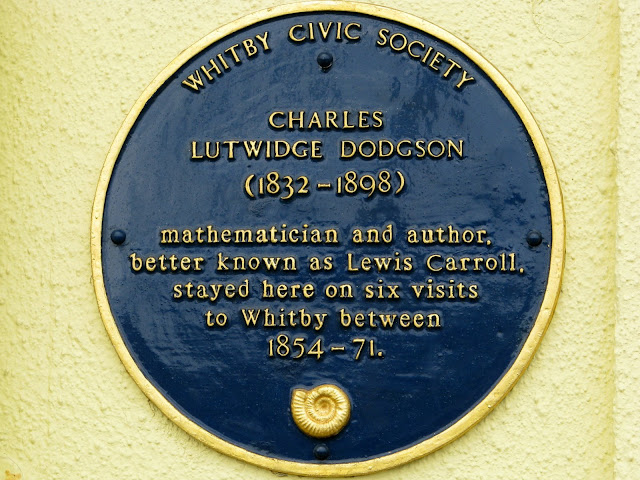
When Lewis Carroll first came to visit Whitby in 1854, it was as a 22 year old student of Christ Church college called Charles Lutwidge Dodgson. Included as a member of a Mathematical Party, Dodgson’s apparent reason for the trip was to give a series of academic lectures in and around the town, but the true significance of the visit was later recalled by Dr Thomas Fowler, a fellow member of the same reading party. He said that Dodgson "used to sit on a rock on the beach telling stories to a circle of eager young listeners of both sexes", and he believed that "it was there that Alice was incubated".


The plaque at 5 East Terrace, now La Rosa Hotel

It is also true to say that whilst on his visit to Whitby in 1854 Dodgson had his first piece of work published, a satirical poem called The Lady of The Ladle, which appeared in the local newspaper the Whitby Gazette. Dodgson was also composing a poem at the same time called She’s All My Fancy Painted Him, which went on to form the basis of the White Rabbit’s ‘evidence’ at the trial of the Knave of Hearts.

Dodgson felt these and subsequent work to be of a substandard quality saying in 1855, "I do not think I have written anything worthy of real publication (in which I do not include the Whitby Gazette or the Oxonian Advertiser), but I do not despair of doing so some day".

The first use of the pen name Lewis Carroll appears in 1856 with the publication of a romantic poem called Solitude. Dodgson’s pseudonym was actually a play on words, Lewis was the anglicised form of Ludovicus (the Latin for Lutwidge) and Carroll an Irish surname similar to the Latin name Carolus, from which the name Charles is derived. In this same year Henry Liddell became the new Dean of Christ Church, bringing with him his family including his daughter Alice Liddell.

Alice Liddell

Little is known of Carroll subsequent visits to Whitby (seven in all), but considering that Alice’s Adventures In Wonderland (1865) and Through The Looking Glass And What Alice Found There (1871) had both been published in the interim and both had met with critical acclaim as well as considerable success, he may well have used the town as a pressure valve enabling him to escape the trappings of his new found fame.

Tenniel's illustration of The Walrus and the Carpenter

The only other significant connection between Lewis Carroll and Whitby is the poem The Walrus And The Carpenter found in Through The Looking Glass, which was thought to have been inspired by Carroll’s walks along Whitby beach. Whatever influence Whitby had on Carroll’s literary output, it can be assumed the unique ambience of the town and the surrounding area played an important role in his imaginings, and that he certainly had a place in his heart for the little town lost somewhere between the land and the sea.

Read the whole of The Lady of the Ladle and Coronach, another poem featuring Whitby, here.

Source material: The Origins of Alice By Derek Hudson
Wikipedia - Lewis Carroll

Many thanks to Richard Locker for writing this article.

Saturday, 20 March 2010

CAPTAIN SCORESBY AND THE POLAR BEAR

Featuring Buzz Lightyear as Captain Scoresby

The whaling ships that sailed to the Arctic from Whitby would take polar bears as well as whales. These could be sold to zoos and fairs for a tidy price. Frequently a mother and cub would be encountered by the crew in the desolate landscape of the northern ice field.


This story is of a polar bear captured by the most famous of 18th century whaling captains, William Scoresby senior of Whitby.


It seems a member of Scoresby's valliant crew came upon a female bear and her cub and carried out the usual protocol. It was customary to dispatch the mother with a well aimed shot. Often the cub would be more puzzled and frightened than vicious. It was swiftly trussed up and taken back to the ship.


Usually the cub would be kept in a barrel with bars over the front for the entire voyage. Maybe a fish would be tossed in every now and again, occasionally the hapless animal would be doused with a bucket of sea water.

Scoresby however fastened this particular bear to a point on the deck. With a regime of painful taps to the bear's black nose and rewards of whale meat for good behaviour, the good captain was able to lead the cub round the deck on a rope leash. By the end of the season he considered it tame.


Unfortunately, once the ship was back in Whitby, the unfamiliar noises and smells of the port confused the bear. It reared up on its hind legs, broke free of its tethering and ran off through the town, disappearing into the alleyways and yards.


Eventually a posse of angry men surrounded the bear in Cockmill Wood. With weapons at the ready, they were quite prepared to kill the beast if need be.
...

Much to everyone's surprise, Captain Scoresby added to his reputation by pushing his way through the rabble before anyone was injured. He walked up to the cub which proceeded to lick his hand with its long black tongue, welcoming back its master. He tied a length of rope around its neck and led it peacefully away, much to the relief of the assembled townsfolk.


Soon afterwards the bear was taken to London's Tower Zoo where it eventually died.


No animals were harmed in the production of this featurette.

Saturday, 6 March 2010

ST. OSWALD'S CHURCH, LYTHE

In Domesday Book the manor of Lid, now called Lythe, was held by someone called Nigel. There is no mention of a place of worship until 1100, when Nigel's son is recorded as making a grant of the church at Lythe to Nostel Priory, near Wakefield. In 1154 Robert, Priest of Lythe, is mentioned in an ancient document. These are the earliest written records of the Church.

1910 was the last time St. Oswald's Church was restored. Built into the walls and buttresses of the old church, many ancient carved stones were discovered which helped to shed light on the distant origins of worship at the site.

Examination of these precious finds showed that two of the stones were Anglo-Saxon, dating back to the 7th or 8th centuries. These may indicate the existence of a stone church at Lythe prior to the Viking invasion and contemporaneous with Streoshalh, the abbey of St. Hilda destroyed by the Vikings, which they renamed Whitby.

The majority of the stones are Anglo-Scandinavian, of late 9th to early 10th century origin. They are all funeral monuments, or fragments thereof. A striking crosshead is noteworthy because the face at the centre of the cross has no halo and therefore may not necessarily depict Christ.


A long heavy 'hogback' gravestone was found to show a previously unknown carving once it was cleaned of moss and lichen. A simple figure thought to represent the norse god Tyr is depicted being attacked by two wild animals, possibly wolves. He's become known as the Gingerbread Man, for obvious reasons.

There is also a collection of later stones from the Norman church. The old walls on the North and East sides of the church were probably their work. A large stone coffin also stands in the aisle of the church as part of the permanent exhibition.


A selection of stones are on permanent display and the church is open daily. Many more are stored in the crypt and can be viewed by special arrangement.

Thursday, 25 February 2010

THIN ICE


12 January 1891

On Saturday the weather continued frosty and fine at Whitby and the neighbourhood, and hundreds of young people were out on the ice skating on Ruswarp dam and on the River Esk adjoining the Carrs.
...
A sad fatality occurred on Ruswarp dam, at the lower part. A young man named James Bell, about 19 years of age, son of Mr.George Bell, fishing boat proprietor, ventured too far down the dam, where the ice was not quite so firm as in the upper reaches.

The ice suddenly gave way, and he was submerged. An effort was made to rescue him by Mr.Naylor, of the Home and Colonial Stores, but the unfortunate young man disappeared beneath the ice. The body has not yet been recovered.
...
From The Times 1891

Sunday, 21 February 2010

0°C 21.02.10


Click to expand the images

EN PLEIN AIR

FREDERICK WILLIAM JACKSON 1859-1918

Gilbert Foster, Fred Jackson and Mark Senior had been painting in Staithes from about 1880. The group that formed around them became known as The Staithes Group. Despite the lack of a strong leading figure, such as Stanhope Forbes at the artists' colony in Newlyn, the Staithes artists held a strong belief that art should not be shackled by the rigid conformity of the establishment. Indeed they split from the Yorkshire Union of Artists and held their own independent exhibition for the first time in 1901 at the Fishermen's Institute in Staithes.

Frederick William Jackson is often falsely referred to as an English impressionist. Many of the Staithes painters had studied on the continent and the influence of impressionism can certainly be seen in their work, but it never hides an underlying draughtsmanship and a solidity of form. They never fully submerged themselves in its essential spirit.

The French painter Bastien Lepage belonged to group of watered down impressionists known as Juste Milieu (Middle of the Road). Leplage was a huge influence on Fred Jackson, particularly with the idea of 'plein air' painting.

Fred Jackson and Laura Knight on the beach at Staithes

Artists painting in the open air is a common sight in Whitby and the surrounding area these days, but when the impressionists first took their paints and easels outside to capture, for instance, the changing quality of sunlight at different times of the day, it was quite revolutionary.

Plein air painting also became the fashion in the artists' colony at Newlyn in sunny Cornwall. The Staithes painters however had to cope with all the bad weather the North Sea could throw at them. Their dedication to plein air often took its toll. John William Howey, for instance, died in Hartlepool in 1938 from typhus caught by drinking contaminated water whilst painting en plein air.

Horse drawn Sled in the snow by F. W. Jackson

In 1914 Fred Jackson visited Russia where, despite the freezing weather he continued to paint outdoors. Many consider these paintings to be his most vibrant and innovative.

The artist Laura Knight said this of Jackson in her autobiography:
'He painted out of doors in any weather. Under the mittens he wore, his hands were swollen, stiff and chapped, as were the edges of his ears and the wings of his nostrils.'


Fisherfolk at Runswick by F. W. Jackson
...

Fisherwomen by the Quay at Staithes by F. W. Jackson

Monday, 1 February 2010

GALILEE BREAD

Mrs Alice Galilee owned a cottage in Jackson's Yard which she rented out. In 1847 she made a bequest that the income from the cottage should go towards providing bread for the poor of the parish.

As you enter St. Mary's Parish Church, Whitby, the first pew on the left hand side is the churchwarden's pew. On the wall above the pew is a rack on which this bread was placed. Charity bread cupboards and traditional bread doles are not uncommon, like the ones at Cartmel Priory and Kirkby Stephen for example, both in Cumbria.

The fund provided by Mrs Gallilee has now been merged into the Whitby United Charities, and the bread is now no longer placed there before every Sunday morning service. The custom still continues on the main festivals of the Church's year though.

I have it on good authority that bread from Woodhead's bakery is prefered to that from Botham's as it lasts longer.

This is not meant as an endorsement of any particular bakery. As well as the two mentioned, other quality purveyors of bread and bread related items are available in the town. Remember bread prices may go up as well as down.