
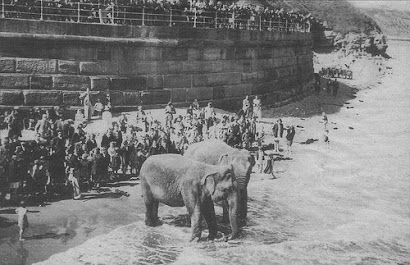
Here's an old postcard showing the piers in their prime at the turn of the last century.
 Beadlet Anemones are the main food source of the Common Grey Sea-Slug Aeloidia papillosa, whose eggs can be seen here. The sea-slug can transport the undigested stinging cells from the anemone's tentacles into the fleshy outgrowths (cerata) on it's back, where it can use them for it's own self defence.


 The stone on the left is inscribed 'SNEATON LIBERTY ASSIZES 1784'. This photo was taken looking in the direction of Pickering.
 Looking towards Whitby, the other stone reads 'Goathland Boundary Determined at York Assizes 1818'.
 This map shows the parish boundaries as they were before 1832 when the Civil Parishes started coming into being. The approximate site of the stones is marked by a red dot. The large parish that borders Sneaton is Pickering.
 This depiction of Whitby's west pier was drawn into the sand under the Spa on Sunday July12th by an unknown sand artist. The depiction of the stonework is particularly impressive.
 This large and rather perfect sand circle was made on the same day in the same area. It reads 'NATIONAL STREET CHOIR FESTIVAL - WHITBY 2009.' On the right of the circle are the words 'THANX WHITBY.' A podcast of street choir singing from the festival can be found here on The Whitby Independent.
 This is the scale worm Harmothoe imbricata. Scale worms of the family Polinoidae are Annelids just like earthworms, that is to say they have segmented bodies. H. imbricata has 15 pairs of overlapping scales known as elytra.

Another as yet unidentified scale worm. Much smaller than Harmothoe imbracata at 1cm long. The scales do not overlap and they don't cover the entire body. Hopefully someone at the Marine Wildlife of the N. E. Atlantic group will give me a positive ID in due course.
 This object was found attached to the underside of a stone quite high up the shore. It has been identified by Richard Lord via Marine Wildlife of the N. E. Atlantic as the egg mass of the sea slug Aeolidia papillosa.
Known as the Common Grey Sea Slug, it feeds on sea anemones and lays eggs at specific times each year. In Guernsey the adults arrive to spawn in March and May and then disappear again. Presumably with Whitby being so much further north, spawning occurs later. I've never seen evidence of sea slugs in this area before.
...
The above picture shows the egg mass out of the water. The picture below shows the same mass submerged with a 1p piece for size reference.


 'My building has every convenience,
 ' I love to go to the playground
 'And out of the ground made the Lord God to grow

 'Where there is a virgin piece of ground to work upon,where the canvas is clear,
 ' The quay of the haven of the town [which is] much decayed and broken down,
 Whitby Woolworth's number on closure list - 196

'This Pannet Park
belongs to the people of Whitby
not Scarborough Councillors' Quango Committee.
Who stole our trees? '
Unknown writer - On a sign in Pannet Park
 Francis Kildale Robinson was born in London in 1809, but he was not destined to live in the capital all his life. He became a resident of Whitby, and for a period of time he worked at a chemist's shop in Baxtergate.
 Published in 1855 by John Russell of London, it is a dictionary of a forgotten vocabulary that developed in this isolated community cut off by the moors and the sea. 'In recluse districts we may expect to find the greatest number of genuine provincialisms — of Ancient Vocal Sounds' he wrote.



