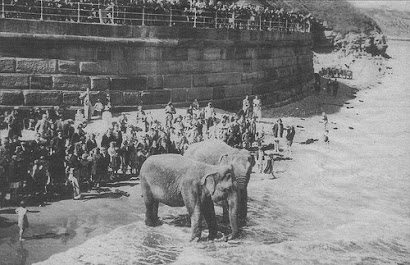
ELEPHANTS ON WHITBY BEACH

ELEPHANTS ON WHITBY BEACH

Sunday, 27 September 2009

MAHARAJAH DULEEP SINGH

The colourful life of Duleep Singh reads like a pulp romantic tragedy. The Maharajah of Lahore was born into fabulous wealth in 1838 when Britain was involved in a fierce struggle for Punjab.

In 1849 his mother was imprisoned, Punjab was annexed by Britain and the 11 year old Maharajah was deposed.

He came to England in 1854 and became a great favourite of Queen Victoria. He lived through his teens and into his twenties in Scotland, where he was known as 'The Black Prince of Perthshire'. He enjoyed game shooting and became well known for hosting lavish receptions and entertainments.

In 1860 he returned to India to rescue his mother from political exile in Nepal. Four years later, after the pair had become regulars on the society scene, she suddenly died. He returned to India to cremate her and arrived back in England with Bamba Muller, a girl from a Cairo mission school who became his wife.

They lived in Elveden, Surrey. Duleep Singh transformed the run-down estate into a modern, thriving game preserve. The house became a semi-oriental palace with huge paintings, grand sculptures and cases of jewels reminding visitors of his former status.

Even so he became dissolute, took mistresses, fathered illegitimate children and used up his generous allowance forcing him to beg for more from the Queen. With a sense of burning injustice, he returned to India in 1886 to place himself as the lawful sovereign of the Sikh people. Unfortunately he was arrested at Aden and returned to Europe.

After a miserable few years in Moscow he came to beg official pardon from the Queen. Duleep Singh was now a broken man. In 1893 the Maharajah of Lahore, who placed the fabled Koh-I-Noor diamond in the hand of Queen Victoria, died of an epileptic fit in a lonely hotel room in Paris, penniless and shattered.


THE MAHARAJAH OF MULGRAVE

For four years, between 1859 and 1853, the Maharajah rented Mulgrave Castle from the Marquis of Normanby who was then the British Ambassador in Florence. He was often seen hawking on the moors in full Indian regalia accompanied by English gamekeepers in scarlet uniforms.

The Maharajah had a road between Sandsend and Whitby constructed following in part the line of the current route. It considerably shortened the distance by road between Mulgrave Castle and Whitby. Indeed the toll booth still remains, and tolls were being collected until 1925.

Unfortunately the legend that Duleep Singh had the road built because his elephants objected to walking along the beach cannot be verified. There is no evidence that elephants ever resided at Mulgrave.

Indeed there is no evidence that elephants don't like sand between their toes, as this photograph clearly shows. Probably taken in the early 1900s, after the death of Duleep Singh, these two seem quite happy on the sands below the battery. They were probably from a visiting circus.

PONY AND TRAP

This pony and trap was seen on Whitby beach last weekend enjoying a trot along the sands in the afternoon sun.

Nice to see the old traditional forms of transport being kept alive. This picture shows Mr and Mrs J. Tinsley and their son William at Low Farndale around 1905.

Tuesday, 22 September 2009

RUSWARP


Here's an old postcard showing Ruswarp High Street minus traffic.
The old Post Office was on the left and has closed down, probably to be converted into accommodation. Rowing down the Esk is thirsty work so the Post Office was always handy for an ice pop before walking back to Whitby over the fields.

Saturday, 19 September 2009

WORD OF THE WEEK #3

In A Glossary of Yorkshire Words and Phrases Collected in Whitby and the Neighbourhood of 1855, the following word crops up and helps to explain a local place name.


Upgang viaduct fell into disuse after 1958 when trains ceased running from Loftus to Whitby. Passenger numbers dwindled significantly after the war and the cost of maintaining the line, particularly the five poorly built viaducts, became prohibitive. They were at Staithes, Sandsend, East Row, Newholme Beck and Upgang.

The structure was 86 feet high at its furthest point from the ground and about 300 feet long. It contained approximately 200 tons of steel. Demolition of the pillars was made difficult because they were filled with concrete, an estimated 12 tons in each. The workmen had to cut through the concrete base of the pillars, and then pull them over.

All salvaged material was cut into 4ft.6in. by 2ft.6in. pieces before being despatched as scrap. It is thought a large proportion of it went into making sea defences.

Friday, 4 September 2009

MOTH OF THE DAY #2

Not really a moth actually, but the caterpillar of a moth.

This fat fellow in the hairy jersey is the larva of the Buff Tip moth. I found this one crawling over the yard, probably looking for a suitable bit of earth in which to pupate.

The caterpillars feed in colonies and can often strip every leaf from a branch of their favourite trees. They're particularly partial to oak, birch and sallow, but will eat almost any leaves if need be. The adult moth will emerge next June, but they are rarely seen except when attracted to a light.

RUINED ABBEYS

In 1891 Seely and Co. published William Chambers Lefroy's 'The Ruined abbeys of Yorkshire.'

Whitby Abbey is the last one featured, so its quite a scroll through to get there, a bit like climbing up the 199 steps. The illustrations are by A. Brunet-Debaines and H. Toussaint and are uniformly beautiful. Lefroy's prose paint evocative pictures of Yorkshire's past with a keen sense of rhythm and poetry.


You can actually read this book without leaving the blog. One click on the + sign makes it large enough to read. Whitby Abbey is on page 272.

Thursday, 27 August 2009

SISTERS OF SORROW

The German U-boat UB41 was built in Hamburg at the shipyard of Blohm and Voss. She was launched on May 6th 1916, and sank 8 ships during her naval career. The last time she was seen above the waves was on October 5th 1917 by the SS Melbourne in the seas off Scarborough, under the command of Oberleutnant Max Ploen.

It was always assumed that she fell victim to a mine off Scarborough, but in 2003 she was found 30 miles away from where she was thought to lie. Nearby lies UB75. Both wrecks are considered war graves, as 58 submariners went down with the vessels.

They were discovered by divers Carl Racey and Andrew Jackson, who were unable to tell whether they'd struck mines or suffered internal explosions.

According to Andrew "The early submariners of WW1 were true pioneers of submarine warfare. These vessels were hard mistresses to crew and officers alike, often referred to as Iron Coffins or Sisters of Sorrow."

Here's a video of the wreck of UB41.


See more local wrecks at the Subseatv YouTube page.

Thanks to Mark Lines for information about this fascinating subject.

Monday, 24 August 2009

WORD OF THE WEEK #2

Here's an interesting one,because there is of course a village by this name up on the moors. Could this be a clue to the origin of that name?

Once again A Glossary of Yorkshire Words and Phrases Collected in Whitby and the Neighbourhood of 1855 was the source.

This is Stape Silver Band, formed in 1884 and still going strong. They entered local competitions in the early 1900s and won many prizes including the 'Jingling Johnny', presented to the band at the first Douthwaite Dale competition. This strange looking trophy now resides in the Castle Museum, York.

Friday, 21 August 2009

I DO LIKE MONDAYS


It's the peak of Whitby's summer season and the 169th historic Regatta starts tomorrow. For many local families the Regatta has always been a much anticipated and enjoyable event. The above photograph, from the turn of the last century, shows huge crowds of spectators watching the rowing events in the harbour. Sadly, some of the unique atmosphere has diminished in recent years, not helped by the loss of the Greasy Pole and the banning of large decorated Floats scattering 'dangerous' sweets into the crowds. However, enough still remains to make this a great 'carnival on land and sea'.

Sunday, 16 August 2009

WORD OF THE WEEK #1

Many of the terms included in A Glossary of Yorkshire Words and Phrases Collected in Whitby and the Neighbourhood of 1855 have sadly become forgotten. In an attempt to reincarnate some of our local expressions, each week one of the juicier ones will be highlighted here on OUT ON YE!

Here's the first selection. I hope you'll attempt to use it in context at some time during the week. If you do, please leave a comment explaining how it went.