ELEPHANTS ON WHITBY BEACH

ELEPHANTS ON WHITBY BEACH

Sunday, 3 April 2011

PEAK ALUM WORKS

The remains of The Old  Alum Works at Ravenscar offer a glimpse into a lost industrial past peculiar to this part of the east coast. Indeed it could be seen as the birthplace of the British chemical industry. What made the development of this complicated process so astonishing is that the science of chemistry was still non-existant. Everything occured as a result of laborious trial and error.

Alum was first produced at Slapewath, Guisborough in 1604. In 1640 Sir Bryan Cooke discovered alum in the rocks at Peak, now more commonly known as Ravenscar. The Peak fault, a shift in the rock strata that occured 350 million years ago, left accessible Lias shales above sea level to the north of Ravenscar, an obvious advantage if you wanted to mine it without drowning.

Alum was used as a mordant for fixing dyes and in the leather industry to render hide supple and manageable. During the 19th century synthetic alum was produced and aniline dyes were invented that didn't require a mordant to fix them. The last alum works to close were those in Kettleness and Boulby in 1871. The industry had lasted for around 250 years.

The Old Alum Works, Ravenscar
Aluminium silicates and iron pyrites were both present in the Lias shales, a feature of the Yorkshire coast's local geology. To produce alum, the sulphur from the iron pyrites and the alumina from the aluminium silicates had to be combined in as pure a state as possible.

Alum shale was dug from two large quarries and burned in huge stacks on brushwood fires. The chemical reaction gave off its own heat, so more shale could be piled on until these smouldering mounds, called clamps, were sometimes as much as 20 metres high. They burned for a full nine months, after which the whole rock became red in colour.

The 'calcined' shale was then steeped in pits of water to extract aluminium sulphate. The liquor was run off into settling tanks and the remaining red rock, known as 'mine', was dumped either on or over the cliffs. These spoil heaps are now the preferred habitat of yellow flowered gorse bushes.

One of the stone drainage channels
The liquor was then boiled in a Boiling House in pans over iron plates. This part of the process relied on huge quantities of coal which was brought to the works by sea. A stone lined winding house which once contained the winching machine remains at Ravenscar, iron fittings and spindle wheels still intact. It was used to haul coal deliveries up the cliff, and to load the finished alum product onto ships in the dock below.

The next stage of the process was to introduce potassium and ammonia. Potassium was obtained by burning kelp seaweed in huge quantities and adding the resulting lees to the mixture. As for ammonia, stale human urine was shipped into the works in huge barrels. It was said that poor people's urine was better as it was not the product of such strong drink.

The Winding House
In the heyday of urine usage people put it out on their doorsteps in jars ready for collection, buckets stood on street corners and special urinals were built in cities for the purpose. It was shipped in from such places as Newcastle and London in barrels in lye boats.

When the potash and ammonia was added to the brew it was left to cool and alum crystals gradually formed. The liquor could be reboiled time and time again to maximize the yield.

The industry has left indelible scars on the local landscape. A burning floor on the cliff above Sandsend has left a large, desolate area of bare shale reminiscent of the lunar surface. Remains of stone breakwaters and berthing points can be seen at Saltwick Bay and in many places the entire profile of the cliffs has been changed by alum mining.

Peak alum works as it is today
(Click on the photo for a larger image)
The site is now owned by The National Trust and is free to visit. It is well signposted from the Cleveland Way.

Thursday, 17 March 2011

MOUNTING BLOCK ON BACK ST. HILDA'S TERRACE

I've been past loads of times and never noticed this mounting block near the Fire Station at the top of Back St. Hilda's Terrace. Maybe someone knows why it might be there rather than somewhere else?


Update: Chris Corner explains that Back St. Hilda's Terrace used to be lined with stables and carriage houses for the well off inhabitants of St. Hilda's Terrace itself.  Being rather well fed and possibly a bit rotund, the residents would need all the help they could get to mount their horses.

St. Hilda's Terrace was originally known as New Buildings, and there seems to have been an attempt to change the name to King Street at some point. An inscription on number 14 gives a date of 1779. It is a row of 25 houses which display a considerable variation in size and layout.

Sunday, 13 March 2011

WADE'S CAUSEWAY

One damp, grey February morning I resolved to visit the ancient road over Wheeldale Moor, it seemed high time I did an item about this strange, enigmatic structure. Unfortunately I didn't have my hiking boots with me, they were in my wife's car boot, so although I was suitably attired for the prevailing drizzle, sadly I was poorly shod against the perils of sodden ground.

The course of the road, with Hunt House to the
 north and Wheeldale Bridge to the south
After driving through Goathland from Whitby I turned onto the moor and took a left turn down Hunt House Road. Pulling up in a layby where the pathway marked 'Roman Road' leads off, I sat and had some lunch and a cup of flask tea. The mist was rolling in over the moorland horizon and the sky was an austere grey. Ideal weather for viewing ancient monuments.

The path led through a meadow and across a wooden bridge over a fast flowing stream, then a track continued up through a field at a moderate gradient. This is where my less than adequate footwear caused a bit of bother. It was very wet and slippery and by far the easiest way was to walk on the grass at the side of the track.

After a bit of mud skating and almost falling down several times, a gateway led out onto the edge of the moor. A notice board  explaining the legend of Wade, a map of the road's route and a couple of diagramatic cross sections had been erected in a large puddle. Luckily some kind soul had placed a plank across the water so I balanced on it precariously and read the informative text. One of the illustrations showed Wade himself actually lifting a huge stone to build the road so his wife Bell could herd her sheep over the moorland pastures.

The first part of the Wheeldale road as it rises from Hunt House onto Wheeldale moor
The course of the road leading from here is made of sandstone slabs set amongst rough grass on a low embankment. Once these stones obviously formed the metalled surface layer. Stones are set on their sides along some parts of the edges of the road forming a kerb. A layer of gravel laid over the closely fitted sandstone slab metalling once formed the upper surface, and presumably the kerbstones helped to keep this in place, as well as preventing the sandstone slabs from sliding off their embankment.

It gently curves and rises before a wall crosses the road. From thenceforth the landscape changes to heather moorland and the road can be seen disappearing in the mist as it heads toward Wheeldale Bridge. Low clouds ominously rolling over the coniferous woodlands on the horizon and the remoteness of the location add to the overwhelming sense of mystery and wonder, because the construction of this ancient carriageway must have been a collossal undertaking.

In places where streams cross the route, the channels are bridged by stones from the road. Also it's quite clear that metalling slabs have been used in the building and repair of many nearby drystone walls. 

Stones from the road used to bridge a stream
The work to expose the road as we see it now was undertaken by Mr James Patterson between 1912 and 1920 on behalf of the Office of Works. He found no pottery or coins during the course of his work. In fact the only relics he came across were human remains, described as a contracted skeleton, discovered in a small roadside burial cist made of slabs set on edge then covered by a large, flat stone. The remains found by Patterson and the coverstone to this cist have long since disappeared.

Although often called a Roman road, the actual date of construction has been the subject of much debate. In many ways it doesn't fit the typical profile of a Roman road. It has been suggested that it may even be part of a Neolithic boundary of some sort.

Over the heather towards Wheeldale Bridge
The following extract from a letter by Stockton based archaeologist Blaise Vyner published in British Archaeology, no 29, November 1997, serves to illustrate the lack of clarity about its origins, even amongst experts.

'I should like to comment on the 'road' across Wheeldale Moor, which you illustrated on the front cover. This structure is often referred to as one of the best surviving instances of unaltered, though robbed, Roman road construction. However, apart from being roughly on a line drawn between Cawthorn Roman camps and the Roman fortlet on Lease Rigg, it has none of the characteristics of a Roman road. It is restricted to Wheeldale Moor, and follows a sinuous course. It is also broken by watercourses. For some time I have suspected that this monument is in fact a Neolithic or Early Bronze Age boundary line'

As the ground became more and more sodden due to the constant drizzle, I decided that it was time to call it a day and retreat back to civilization. The purchase my relatively smooth soled shoes were obtaining on the slippery, lichen clad rocks, wet heather and couch grass was growing ever more tenuous. It would have only been a matter of time before I was face down in a peaty puddle with a mouthful of sphagnum moss.

Clearly I need to go up there again, but wearing more appropriate footwear and possibly another jumper. I would however feel somehow cheated if a warm sun was shining in the sky and bees were busy collecting pollen in the blooming heather. Ancient and mysterious monuments require a cloak of swirling mist and a penetrating wind that keeps everyone but the most intrepid visitors away.

Link to the full text of Blaise Vyner's letter

Sunday, 6 March 2011

SCALEWORMS

This large (4cm) scaleworm is probably a specimen of the species Harmothoe imbricata, although to identify thes creatures correctly it is necessary to use a hand lens and to examine the scales (elytra) in some detail.

Scaleworms are relatively common at Sandsend, Robin Hood's Bay and Kettleness etc. They cling to the underside of stones and can be easily missed. These photos were taken with the worms immersed in water, but when they're out of the water their colouration allows them to blend into the surface.

Harmothoe imbricata showing the two characteristic rows of fifteen scales (elytra), although the hindmost elytra on the right side is missing.
This second worm is probably another example of Harmothoe imbricata. At 2cm its much smaller and sports a completely different colour scheme. It has a rich chestnut coloured band down the centre and a white edge to each scale. Although it looks like poor camoflage, actually against corraline seaweeds and lichen, the pattern works well.
  
? Harmothoe imbricata wearing an alternative colour scheme

Breeding on our coast occurs during March and April. The females spawn twice during these months. Sperm are released onto the eggs which are held under the female's scales where early development takes place. Scaleworms can live for around four years.

Both were found at Sandsend on 25:02:11.

Monday, 28 February 2011

WHITBY IN FEBRUARY


"Haunted Harry's"
C. Corner

Sunday, 30 January 2011

WHITBY IN JANUARY


C. Corner

Sunday, 23 January 2011

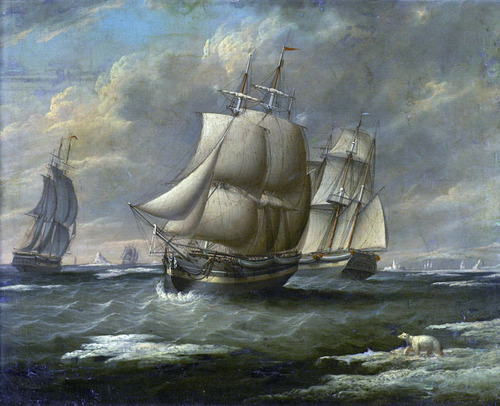
THE WHALER FLEET

By RICHARD LOCKER


The Whaler Fleet is a sentimental poem written by the Victorian gentleman Arthur J Munby. It recounts a tragic incident which occurs during a whaling voyage to Greenland and the frozen north, the story is told from the perspective of a loved one awaiting the return of the fleet.

THE WHALER FLEET

Full merrily sail’d our whaler fleet
When the wind blew out to sea;
Any many a one came forth to greet
Each good ship’s company.

For there was the Dove and the Good Intent
(How the wind blew out to sea!)
And the Polly o’ Sleights with her bran-new sails;
But the Mary Jane for me!

Oh, Captain Thwaites of the Mary Jane,
When the wind blew out to sea,
Full many a time his ship had sailed,
Full many a time had he.

He has Jack of Grosmont and Tom o’ the Staith
(How the wind blew out to sea!)
And Handsome Jim from Hayburn Wyke;
But ‘twas Robin Hood Will for me.

My Willy he kiss’d me before them all,
When the wind blew out to sea;
My Willy he stood the last on deck
A-waving a cap to me.

So off they sail’d out over the main,
While the wind blew out to sea;
Till the ice was all under their beamed bows
And the ice drove under their ice.

The months they went and the months they came,
And the wind blew out to sea;
Any many a time in the stormy nights
My mammy she wept with me.

But when the harvest moon came round,
And the wind blew in from the sea,
‘Twas merrily came our whaler fleet
All home from the north country.

The folk they call’d and the folk they ran,
And the wind blew in from the sea;
From the tick of the town to the lighthouse tower’
‘Twas throng as throng could be.

I saw them atop of the old church stairs,
When the wind blew in from the sea;
And the waves danced under their beamed bows,
And the foam flew under their lee.

I saw them at foot of the old church stairs,
When the wind blew in from the sea;
And the foremost ship of our whaler fleet
Was rounding the lighthouse quay.

Oh there’s the Dove and the Good Intent,
(Still the wind blew in from the sea),
And the red red sails of the Polly o’ Sleights-
Her men as plain to see.

Now every each hath pass’d the bar,
And the wind blew in from the sea;
And every each lies in harbour lies,
Right up against the quay.

But where, oh where, is the Mary Jane,
Now the wind blew in from the sea?
There’s many hath clipt his lass,
And when doth my lad clip me?

“Oh tell me where is the Mary Jane,
For the wind blew in from the sea?”
“The Mary Jane went down by her head
With all her company!”

And take me home, for I care not now
If the wind blows in from the sea;
My Willy he lies in the deeps of the dead,
But his heart lives on in me.

Arthur J Munby (1828-1910)

Munby was a relatively successful poet and had numerous pieces published in his lifetime, although he was only ever considered a minor writer of the Victorian era. It would only be after his death in 1910 when the true scale of his writings were revealed with his private diaries ‘Working Women In Victorian Britain 1850 - 1910’, a collection that ran to some 69 volumes in all.


These intimate diaries exposed Munby’s secret world and a life that was a far cry from the public demeanour he projected as an officious civil servant working at the Ecclesiastical Commissioners office. As the title suggests the diaries are an in-depth study of working class women from the Victorian era, but it is Munby’s idiosyncrasies which give the works a rather dubious reputation.

In them he describes how he would frequent the cities poor urban districts, where he could freely converse with these women, asking them about their lives, where they worked as well as the conditions they worked in. He would often make sketches of the women as well as writing detailed descriptions of their clothing and dialects. It is now considered that Munby may have had a form of mysophilia - a fetish for soiled and dirty materials or people - but he would vehemently deny that his ‘Hobby’ had any prurient elements.

 Hannah Cullwick in various guises, including that of a housemaid, a lady and a male negro slave.


In 1854 Munby began an affair with a Shropshire born maid-of-all-work called Hannah Cullwick. The peculiarities of this relationship saw Munby take on the roll of master whilst Cullwick became his willing slave, they also involved other forms of fetishism including age play and infantilism. Even after their secret marriage in 1873 the relationship remained the same, apparently on Hannah’s behest. But by 1877 the couple had grown apart and Cullwick left Munby to return to her previous profession as a maid. It is thought Munby continued to visit Hannah right up until her death in 1909.

Although there is no evidence that Munby ever visited Whitby, the poem appears to suggest that he knew the town well, with it’s detailed description of the harbour and a familiarity with the names of the surrounding villages (Munby himself was born only forty miles away at Clifton in York). Plus the fact that Whitby at the time was one of England’s largest whaling ports and an industrious hive of activity, means the he would probably have found the town a very enticing destination.
WHY I LOVE BRYOZOANS


Turning over stones in rockpools at low tide is a popular pursuit of holidaymakers, usually hoping to find a crab feverishly scuttling for cover under a mass of seaweed, or a small fish darting in the blink of an eye into some nook or cranny. If only they looked more closely at the rock itself, because some truly strange creatures can be found clinging to its surface.

Bryozoans are tiny colonial animals that live surrounded by a cuticle of resilient material, rather like the rooms in a block of flats. Usually less than a millimetre in length, each individual is known as a zooid. Sometimes the colonies form encrustations on rock surfaces ( hence they are sometimes known as sea mats ), but some species form branching structures often mistaken for seaweed.

Hornwrack: Flustra foliacea

A close-up of a frond of Hornwrack
...
The photographs above show Hornwrack. This is often cast up on the beach in large quantities after a rough sea. It looks for all the world like a piece of dried up seaweed, but it feels quite different. It has a rough, sandpaper-like surface. On closer examination the seperate compartments each bryozoan inhabits can clearly be seen.


A colony of Electra pilosa on a stone

Electra pilosa showing the oval zooecia
...
This encrusting bryozoan has more oval shaped compartments, or zooecia as they are correctly called, than hornwrack's rectangular ones. All the members of a colony are the progeny of a single individual known as the ancestrula. In its free swimming larval stage the ancestrula chooses a suitable surface on which to settlefor the remainder of its adult life. The growth of the colony occurs by budding.

It goes without saying that every stone that's turned over in any pool should be put back as near as possible into the same position as it was found. Each one is a tiny ecosystem. Rocky shores such as ours on the North Yorkshire coast support a multitude of fascinating and beautiful plants and animals, and they deserve our respect. They've been around a lot longer than we have. Fossil bryozoans are known from rocks 470 million years old.  Humans emerged about 650,000 years ago.

SILVERING THE BABY


My wife was speaking to someone at work recently who had just had a baby. She was disappointed to have delivered by caesarian section, because it meant she couldn't walk with the pram down Baxtergate collecting money, at least until the wound had healed a bit.

It seems that people, these days often old ladies, will put a coin into the hand of a newborn baby as it passes in the pram. It is meant to make sure that during its life the child shall never want for money. In Edinburgh it is known as 'silvering the baby' and often in the past a siver sixpence was used. Sometimes it was placed under the pillow or a blanket, possibly because it was less likely to be swallowed there.

Similarly a purse should never be given as a gift unless a coin is placed in it first, presumably ensuring it shall never be empty. In Scotland this is known as hanselling the purse. As long as the hansel was left in the purse, others would join it.

Also a knife should never be given without money being paid for it, traditionally the smallest coin of the realm. A promise that the knife would never be used against the giver, called by some 'blunting the knife'. Interestingly the Horngarth or Penny Hedge should rightly be made of sticks cut with a knife purchased for a penny.


Silvering the baby is still carried out in Scotland, Wales and Ireland. In England it seems to be restricted primarily to the north, although it has been reported from as far south as Surrey in the 1950s. Of course these days a 50p or £1 coin is the currency of choice. To a certain extent the connection between silver and babies has been commercialised. A quick look in a high street jeweller's will reveal silver piggy banks, silver spoons and other tacky trinkets.

At least the tradition still flourishes in Whitby. Indeed one mother came home with at least £50 from her first stroll out with the bairn. Still, mum's the word, eh?

WISHING CHAIR UPDATE

As a supplementary detail to our previous post about the Wishing Chair on Stakesby Road, here is what English Heritage say about the site. It explains the shape of the chair and why it is situated at that particular point.

'Medieval cross base situated at the junction of Stakesby Road and Westbourne Road. It is the remains of a mile cross marking the approach to Whitby Abbey. It comprises a block of local sandstone 0.58m wide and 0.55m deep. There is an oblong depression, 0.34m by 0.25m and 0.24m deep cut into the top to serve as a socket. The N edge of the socket has broken away to form what looks like a chair. A modern cross commemorating the 1957 Festival of Britain has been set up on the opposite side of the road, this also marks the mile bounds of the Abbey. '

The cross commemorating the 1951 Festival of Britain