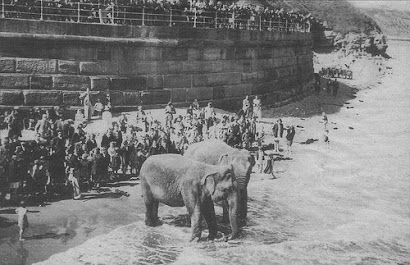
ELEPHANTS ON WHITBY BEACH
Wednesday, 28 July 2010
VESICA PISCIS

WHITBY SMUGGLERS
Yesterday se’nnight The Fawn, smuggling lugger, with a thousand ankers of rum, brandy and geneva, to the amount of 6000 gallons, was taken and sent into Whitby, by the Eagle cutter, Captain George Whitegead, in the service of the revenue of that port; with the assistance of the Mermaid, Captain Carr. The Fawn is a fine clinch built vessel of 90 tonnes built at Flushing four months since, mounting six four pounders and six swivels. Her crew consisted of twenty two men. The Whitby Times, 31st August 1790
Hidden away in the remote recesses of the North Yorkshire coastline, Whitby with it’s cosseted natural harbour and dark labyrinthine network of Ghauts, Ginnels and Yards seemed perfectly placed to play an active part in these acts of ’free trade’. And with rumours of an underground tunnel system existing beneath the town, the profiteers would easily have been able to secure their ill gotten gains safely, away from the prying eyes of the government’s ’Preventative Men’.
The romantic image of the smuggler as free spirited opportunist belong solely within the confines novels and fictionalised accounts. The truth of the matter was that at sometime or other the majority of the population found in sea side towns up and down the country, would have been involved in or at least benefited from this illegal trade. From the fishermen who used their boats to ferry the cargo to shore to the farm labourer who would then lug the smuggled items inland.
In Whitby, when a cart laden with smuggled kegs crossed the moors, it was usual to have one keg at the back of the cart ’ with a quill in it’, and passers-by were cordially invited to sample the contents of the keg, a convenient method of persuading them to keep their mouths shut. When the cart approached it’s final destination, the quill was withdrawn and the keg properly spiked. Extract taken from ‘Whitby Lore and Legend’ By Shaw Jeffrey
Even the men sent to stop these illicit actives could find themselves embroiled in the trade:-
Captain Harold Hutchinson of the Dragoon Guards based in Guisborough was called out to attend what turned out to be a riot of a battle on Whitby’s quayside in the late 1700’s. The Dragoons after quelling the disturbance ended up being ordered to stay in Whitby for three years, enforcing the law as much as they could.
Captain Hutchinson was quickly made Customs Officer, and, as the story goes, managed to avail himself of certain items of contraband before they were spirited away for ’trade’. Such was the extent of his dealings; he amassed not inconsiderable wealth and was able to afford to build a fine dwelling in Skinner Street which became know as 'Harold Mansion'. It is said that success breeds success. Captain Hutchinson knew how to manipulate such a virtue.
As time went on, he turned his mansion into a bordello that was frequently patronised by visiting seamen, servicing a trade that built wealth on wealth for the Captain. Extract taken from the BBC North Yorkshire website
The bordello
It also seems that the people of Whitby had no problem with dispelling the myth of the archetypal smuggler as the following extract shows:-
We are told that during the absence of the men folk at the whale fishery their women kept the home kegs running, and they showed considerable ingenuity in their methods. It was usual for them to fasten a stout leather belt round their waists, under their garments and ’ next their shifts’, and to this belt were hung, all round, bladders of gin or brandy. Extract taken from Whitby Lore and Legend’ By Shaw Jeffrey
In all, the sea port of Whitby during the 18th century was a busy and successful centre of trade, and it seems quite possible that the illegal trafficking of goods played no small part in the town's prosperity, as it was something that any able seafarer could easily turn his hand to with what seemed a very good chance of success.
Text and photographs by RICHARD LOCKER
Sunday, 25 July 2010
CRUMBLING CLIFFS
The view of Whitby from the West Cliff, looking east across the harbour towards the Abbey, must be one of the most well-known and iconic images of the town. One that is reproduced on countless postcards and tea towels. Erosion has been relentlessly nibbling away at the Yorkshire coastline ever since the ice retreated from our shores after the last glacial period.
The image, below, is an impression of how I imagine Whitby might have appeared in the 1070s, just after William the Conqueror's devastating "Harrying of the North" in the winter of 1069-70, but before the restoration of the Abbey by the repentant Norman soldier-turned-monk, Reinfrid.
The Domesday survey was undertaken by the Norman Conquerors to provide proof of rights to land and obligations to tax and military service. It would establish who held what. Whitby's estimated taxable value at the time of the Domesday survey of 1085-86 was 60 shillings. In the years before 1066 Whitby was a thriving town with a taxable value of £112.
The Harrying was an attempt to subdue the rebellious Anglo-Scandinavian population once and for all, essentially an early application of "scorched earth" that King William was said to have regretted on his deathbed. Their intent was to leave the Anglo-Danish insurgents with no means of support, shelter, tools, crops or livestock, thus preparing the way for complete Norman control of the whole of England.
The Domesday entries, describing post-Conquest Yorkshire, make grim reading and are evidence of the effectiveness of the Norman tactics. Nearly all the familiar old villages in the Whitby area are described as "waste", a term meaning no one was productively working the land. Fields lay fallow and churches fell into disrepair. Whitby had a small surviving population and held on to existence but was still described as "almost all waste" in the Domesday Book.
The 11th and 12th century chronicler, Oderic Vitalis, wrote:
"The King stopped at nothing to hunt his enemies. He cut down many people and destroyed homes and land. Nowhere else had he shown such cruelty.
To his shame, William made no effort to control his fury, punishing the innocent with the guilty. He ordered that crops and herds, tools and food be burned to ashes. More than 100,000 people perished of hunger. I have often praised William in this book, but I can say nothing good about this brutal slaughter. God will punish him."
The amount of coastal erosion that has occurred since the building of the East Pier in the 18th century was used as a guide to roughly estimate how much land has been lost in 940 years. When the East Pier was built there was no gap between the Haggerlythe and the pier.
Recent archaeological work on the Abbey Headland has shown that Anglian Whitby was a much larger settlement than previously thought, with houses and workshops covering the entire headland at various times. It is believed the settlement extended far beyond the present cliff edge. Whitby might once have had a Roman signal station like the ones at Filey, Scarborough, Ravenscar, Goldsborough and Huntcliffe. The site of the signal station at Whitby has never been found and has probably fallen into the sea many centuries ago.
Whitby, July 2010

Whitby in the 1070s?

C. Corner
Tuesday, 20 July 2010
KETTLENESS MYSTERY CARVINGS
Monday, 19 July 2010
COMMON GREY SEA SLUG
Once again, under a stone on the middle shore was an example of one of the characteristically spiral shaped egg masses of this fascinating creature. Normally living in much deeper water, these sea slugs come up the shore every year in July and August to spawn.
This time, under another rock I was lucky enough to find one of these elusive, beautiful sea slugs. It was only partially covered with water in its original position, but once placed on a flat stone in a clear pool it could be seen in all its glory.
Aeolidia papillosa
Although known as the Common Grey Sea Slug, the colour of the animals vary according to their local food supply, in this case the red sea anenomes on which it feeds have given it a rosy tinge. They can grow to 120mm in length, although this specimen is much smaller.
Sunday, 11 July 2010
THE PROSPECT OF WHITBY
...

The Prospect Of Whitby is thought to be the oldest surviving public house in London, it can be found to the east of the city centre on the banks of the river Thames at Wapping. Situated within the borough of Tower Hamlets and surrounded by the infamous London Docklands, the pub has what could be considered a long and colourful history.
First built around 1520 during the reign of Henry VIII, the pub’s official name was ’The Pelican’, but as the river commerce increased a more transient population appeared tarnishing the riverside tavern with a dubious reputation. Finding itself host to a nefarious clientele made up of sailors, smugglers, prostitutes, cut throats and footpads the pub would eventually be re-christened the ‘Devils Tavern’ in their honour.
Perhaps the most villainous of the pub’s patrons was the 17th century nobleman ‘Hanging’ Judge Jeffreys. Known as the scourge of the Monmouth Rebellion, he was responsible for the putting to death of over 320 rebel supporters and sentencing a further 800 for transportation to the West Indies.
It was said that the Judge’s visits to the Devil’s Tavern would usually coincide with the hanging of local criminals at Execution Dock. He also enjoyed watching terrified felons being tied to posts on the river bank and left there whilst several tides washed over them. The scene is made all the more macabre by the fact that he was probably the very judge involved in sentencing these people to death.
Not all the pub’s customers were monsters, the famous writer and diarist Samuel Pepys was known to have frequented the establishment, although this was probably for no other reason than to carry out his numerous extra marital affairs in what he might have considered relative secrecy. He would often recount these infidelities in his diaries, as well as making several remarks about disturbances caused by the sailors in the Wapping area.
In 1777, after the Devil’s Tavern had been rebuilt because of damage sustained during a devastating fire, the landlord decided to rename the inn ’The Prospect Of Whitby’ after a square rigged collier called ‘The Prospect’. Built and registered in Whitby, the ship would often be found moored up outside the tavern after delivering it’s intended shipment of coal from the North-Eastern coal fields of County Durham and Newcastle.
In fact the ship became so much of a landmark, that the local people began referring to the pub as ’the one by the Prospect Of Whitby’. So like the Devil’s Tavern before it the name remained, right up until the present day where it is still possible to venture down to the banks of the Thames and buy yourself a pint in what is still considered to be the oldest pub in London.
A victim of The Judge
Thursday, 24 June 2010
SAND SHOES
Saturday, 19 June 2010
CAPTAIN SLEET

'There is no life in thee, now, except that rocking life imparted by a gentle rolling ship; by her, borrowed from the sea, by the sea, from the inscrutable tides of God. But while this sleep, this dream is on ye, move your foot or hand an inch; slip your hold at all; and your identity comes back in horror.'
From The Mast Head , chapter 35 of the novel Moby Dick by Herman Melville.
The book itself is epic in scale encompassing a vast array of themes, including Melville’s personal beliefs on the concepts of class and social status, good and evil, man’s place in the natural order of things, religion and the existence of God.
But this strange tale of one man’s vengeful battle against nature can also be viewed as a rather unorthodox whaling manual, with a variety of chapters about different whale species, including an in-depth analysis of the sperm whale and its secretive behaviour.
A sailor on duty at the Mast Head
There are also large sections of the book concerned with shipboard etiquette and the mechanics of the whale hunt. One such chapter is ‘The Mast Head’ which deals with the art of standing atop the ship’s t’gallant-mast on two thin parallel sticks called the t’gallant cross trees, where it was the sailor’s duty to keep a look out for any sign of the whale.
Melville goes on to describe in great detail a romantic history of the Mast Head and the fact that it has been irrevocably altered by the invention of the ‘crow’s nest’ by the Greenland whaler called Captain Sleet - it seems that the author is having fun at the expense of the Greenland whalers and the extreme weather conditions they had to endure, because when he refers to Captain Sleet he is in actual fact talking about the real inventor of the crow’s nest William Scoresby Senior. Later in the chapter Melville admits to a secret admiration for William Scoresby and his crow’s nest, but still he adheres to the fact that an aspect of seamanship had gone forever. He considers that the endless hours, days and months spend atop the ship’s mast, with nothing but the vast sprawling ocean below and a sailor’s wild romantic thoughts for company, would be all but lost to the poor soul hidden inside the closetted confines of Sleet’s crow’s nest.
'Heed it well, you pantheists!'
STILL LIFE
Barnacles and limpets are a common sight on any of the rocks around Whitby, and you could be forgiven for thinking that the two creatures are somehow related. Indeed for a long time naturalists classified both as molluscs, along with the whelks, mussels, cockles and winkles familiar from seafood stalls.
Its true that both barnacles and limpets are apparently sessile, that is to say they don't move much, and both have similar shaped shells. However in 1830 an army surgeon called J. V. Thompson published a paper snappily entitled On the cirripedes or barnacles; demonstrating their deceptive character; the extraordinary metamorphosis they undergo, and the class of animals to which they undisputably belong.
Thompson, who was an amateur naturalist by inclination, examined the life cycle of banacles and discovered that they had a planktonic larval stage called a nauplius exactly like that of a crab or lobster. The nauplius then went though transformation into another unique stage known as a cyprid.
Thompson found that the non-feeding cyprid had the job of finding a suitable rock or shell on which to settle and spend the rest of its adult life. Once a desirable location was found, the cyprid would cement itself to the surface with its attachment antennae and then form calcified plates around its body becoming a fully formed young barnacle.

Thompson's dilligent work placed the barnacles once and for all alongside the crabs, lobsters, shrimps and prawns in the class Crustacea.
In effect they glue their heads to a rock, build a protective casing around themselves with a door in the top, stick their legs (cirri) out and waft water containing tiny items of planktonic food into their mouths.
This is known as cirral beating, but you have to creep up very quietly to see it in action. Once there is a slight hint of vibration, or once a shadow is cast over the rockpool, the cirri immediately contract back into the safety of the shell in the blink of an eye.

The picture below shows several examples of the common cirripede Semibalanus balanoides on a Sandsend rock. As well as the adults there are plenty of youngsters with much smaller shells which are approximately a month or so old.
Also I've ringed a couple of 1-2 week old light brown post-larval individuals. These are just transforming from cyprid larvae into fully fledged barnacles, but have not yet become calcified.
Saturday, 5 June 2010
THE BATTLE OF BANNIAL FLATT
It was a cold, snow covered morning on the 3rd February 1940, when the crew of the impressively large Radar station situated at Danby Beacon located and confirmed the presence of enemy bombers patrolling the seas off the North East coast of England.
The information was immediately relayed to the only airfield not snowbound that morning at Acklington in Northumberland, which was home to Flight Lieutenant Peter Townsend and the 43 Squadron. Once alerted to the imminent danger a section from B flight was dispatched to intercept the enemy force.
![]() |
| RAF Danby Beacon radar station as it looked in 1940 |
![]() |
| Then Flight Lieutenant Peter Townsend |
“The pilot then gave himself up, however my Great Grandad and the other witnesses did not realise that the German was carrying a gun, luckily no harm came to him or the other witnesses.
As soon as the situation was under control my Great Grandad had to resume his postal duties…..all in day’s work”
A second witness, Roy Steele a ten year old boy from Hawsker, had been helping his Grandfather on the farm that morning when he happened to hear machine gun fire, looking up he saw the approach of the damaged bomber seconds before it crashed into the farm yard.
Quickly coming to the aid of the crash victims the boy was told by his Grandfather to climb into the wreckage and free the gunner who had been trapped in the rear of the plane. Both the surviving airmen were then unceremoniously locked in the farm’s coal house, where they stayed until Special Constable Arthur Barrett arrived with reinforcements.
Upon discovering the outcome of the attack Flight Lieutenant Peter Townsend along with two other pilots went to visit the survivors of the crash in hospital, bringing with them gifts of fruit, cigarettes and a sense of camaraderie for men, who like themselves, faced their fate every time they took to the air. The dead German crewmen were buried with full military honours at Catterick. A wreath was placed on their coffins, with a card that read 'From 43 Squadron with sympathy'.
![]() |
| The crashed Heinkel at Bannial Flatt farm |